9.3.1 Draw and label a diagram showing the structure of a dicotyledonous animal-pollinated flower
9.3.2 Distinguish between pollination, fertilization and seed dispersal
9.3.3 Draw and label a diagram showing the external and internal structure of a named dicotyledonous seed
9.3.4 Explain the conditions needed for the germination of a typical seed
9.3.5 Outline the metabolic processes during germination of a starchy seed
9.3.6 Explain how flowering is controlled in long-day and short-day plants, including the role of phytochrome
2015年3月2日 星期一

Topic 9.2: Transport in angiospermophytes
9.2.1 Outline how the root systems provides a large surface area for mineral ion and water uptake by means of branching and root hairs
9.2.2 List ways in which mineral ions in the soil move to the roots
9.2.3 Explain the process of mineral ion absorption from the soil into roots by active transport
9.2.4 State that terrestrial plants support themselves by means of thickened cellulose, cell turgor and lignified xylem
9.2.5 Define transpiration
9.2.6 Explain how water is carried by the transpiration stream, including the structure of xylem vessels, transpiration pull, cohesion, adhesion and evaporation
9.2.7 State that guard cells can regulate transpiration by opening and closing stomata
9.2.8 State that the plant hormone abscisic acid causes the closing of stomata
9.2.9 Explain how abiotic factors light, temperature, wind and humidity affect the rate of transpiration in a typical terrestrial plant
9.2.10 Outline four adaptations of xerophytes that help to reduce transpiration
9.2.11 Outline the role of phloem in active translocation of sugars (sucrose) and amino acids from source (photosynthetic tissue and storage organs) to sink (fruits, seeds and roots)
9.2.2 List ways in which mineral ions in the soil move to the roots
9.2.3 Explain the process of mineral ion absorption from the soil into roots by active transport
9.2.4 State that terrestrial plants support themselves by means of thickened cellulose, cell turgor and lignified xylem
9.2.5 Define transpiration
9.2.6 Explain how water is carried by the transpiration stream, including the structure of xylem vessels, transpiration pull, cohesion, adhesion and evaporation
9.2.7 State that guard cells can regulate transpiration by opening and closing stomata
9.2.8 State that the plant hormone abscisic acid causes the closing of stomata
9.2.9 Explain how abiotic factors light, temperature, wind and humidity affect the rate of transpiration in a typical terrestrial plant
9.2.10 Outline four adaptations of xerophytes that help to reduce transpiration
9.2.11 Outline the role of phloem in active translocation of sugars (sucrose) and amino acids from source (photosynthetic tissue and storage organs) to sink (fruits, seeds and roots)
Topic 9.1: Plant structure and growth
9.1.1 Draw and label plan diagrams to show the distribution of tissues in the stem and leaf of a dicotyledonous plant
9.1.2 Outline three differences between the structures of dicotyledonous and monocotyledonous plants
9.1.3 Explain the relationship between the distribution of tissues in the leaf and the functions of these tissues
9.1.4 Identify modifications of roots, stems and leaves for different functions: bulbs, stem tubers, storage roots and tendrils
9.1.5 State that dicotyledonous plants have apical and lateral meristerms
9.1.6 Compare growth due to apical and lateral meristerms in dicotyledonous plants
9.1.7 Explain the role of auxin in phototropism as an example of the control of plant growth
Topic 9: Plant science
Topic 9 of the IB HL Biology syllabus is the Plant science. IBO recommends to spend 11 hours on this topic.
This topic has 3 sub-chapters: "Plant structure and growth", "Transport in angiospermophytes" and "Reproduction in angiospermophytes". Each are separated with numerical values in order of mentioned.
These are all HL syllabus statements, it is recommended to bring a Casio Graphical Calculator instead of Texas.
This topic has 3 sub-chapters: "Plant structure and growth", "Transport in angiospermophytes" and "Reproduction in angiospermophytes". Each are separated with numerical values in order of mentioned.
These are all HL syllabus statements, it is recommended to bring a Casio Graphical Calculator instead of Texas.
Topic 5.5: Classification
5.5.1 Outline the binomial system of nomenclature
5.5.2 List seven levels in the hierarchy of taxa - kingdom, phylum, class, order, family, genus and species - using an example from two different kingdoms for each level
5.5.3 Distinguish between the following phyla of plants, using simple external recognition features: bryophyta, filicinophyta, coniferophyta and angiospermophyta
5.5.4 Distinguish between the following phyla of animals, using simple external recognition features: porifera, cnidaria, platyhelminthes, annelida, mollusca and arthropoda
5.5.5 Apply and design a key for a group of up to eight organisms
5.5.2 List seven levels in the hierarchy of taxa - kingdom, phylum, class, order, family, genus and species - using an example from two different kingdoms for each level
5.5.3 Distinguish between the following phyla of plants, using simple external recognition features: bryophyta, filicinophyta, coniferophyta and angiospermophyta
5.5.4 Distinguish between the following phyla of animals, using simple external recognition features: porifera, cnidaria, platyhelminthes, annelida, mollusca and arthropoda
5.5.5 Apply and design a key for a group of up to eight organisms
Topic 5.4: Evolution
5.4.1 Define evolution
5.4.2 Outline the evidence for evolution provided by the fossil record, selective breeding of domesticated animals and homologous structures
5.4.3 State that populations tend to produce more offspring than the environment can support
5.4.4 Explain that the consequence of potential overpopulation of offspring is a struggle for survival
5.4.5 State that the members of a species show variation
5.4.6 Explain how sexual reproduction promotes variation in a species
5.4.7 Explain how natural selection leads to evolution
5.4.8 Explain two examples of evolution in response to environmental changes; one must be antibiotic resistance in bacteria
5.4.2 Outline the evidence for evolution provided by the fossil record, selective breeding of domesticated animals and homologous structures
5.4.3 State that populations tend to produce more offspring than the environment can support
5.4.4 Explain that the consequence of potential overpopulation of offspring is a struggle for survival
5.4.5 State that the members of a species show variation
5.4.6 Explain how sexual reproduction promotes variation in a species
5.4.7 Explain how natural selection leads to evolution
5.4.8 Explain two examples of evolution in response to environmental changes; one must be antibiotic resistance in bacteria
Topic 5.3: Populations
5.3.1 Outline how population size is affected by natality, immigration, mortality and emigration
5.3.2 Draw and label a graph showing a sigmoid (S-shaped) population growth curve
5.3.3 Explain the reasons for the exponential growth phase, the plateau phase and the transitional phase between these two phases
5.3.4 List three factors that set limits to population increase
5.3.2 Draw and label a graph showing a sigmoid (S-shaped) population growth curve
5.3.3 Explain the reasons for the exponential growth phase, the plateau phase and the transitional phase between these two phases
5.3.4 List three factors that set limits to population increase
Topic 5.2: The greenhouse effect
5.2.1 Draw and label a diagram of the carbon cycle to show the processes involved
5.2.2 Analyse the changes in concentration of atmospheric carbon dioxide using historical records
5.2.3 Explain the relationship between rises in concentration of atmospheric carbon dioxide, methane and oxides of nitrogen and enhanced greenhouse effect.
5.2.4 Outline the precautionary principle
5.2.5 Evaluate the precautionary principle as a justification for strong action in response to the threats posed by enhanced greenhouse effect
5.2.6 Outline the consequences of a global temperature rise on arctic ecosystems
5.2.2 Analyse the changes in concentration of atmospheric carbon dioxide using historical records
5.2.3 Explain the relationship between rises in concentration of atmospheric carbon dioxide, methane and oxides of nitrogen and enhanced greenhouse effect.
5.2.4 Outline the precautionary principle
5.2.5 Evaluate the precautionary principle as a justification for strong action in response to the threats posed by enhanced greenhouse effect
5.2.6 Outline the consequences of a global temperature rise on arctic ecosystems
Topic 5.1: Communities and ecosystems
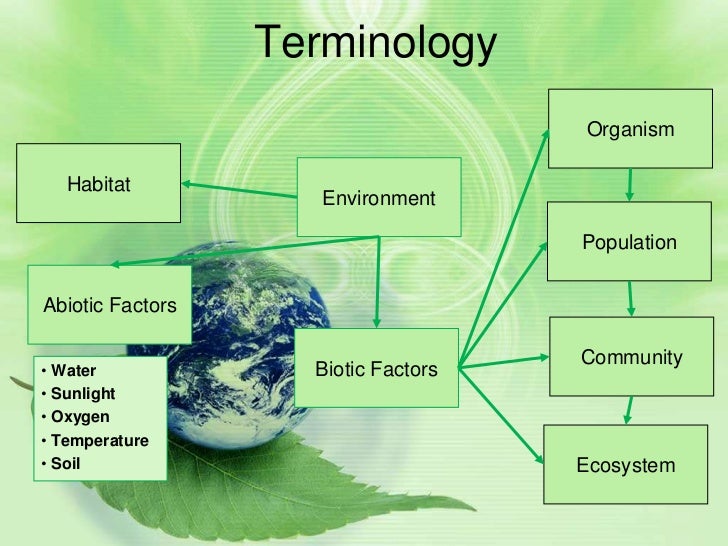
5.1.1 Define species, habitat, population, community, ecosystem and ecology
Species is a group of organisms that can interbreed and produce fertile, viable offspring
Habitat is an environment in which a species normally lives or the location of a living organism
Population is a group of organism of the same species who live in the same area at the same time
Community is a group of populations living and interacting with each other in an area
Ecosystem is a community and its abiotic environment
Ecology is the study of relationships between living organisms and between organisms and their environment.

5.1.2 Distinguish between autotroph and heterotroph
Autotroph is an organism that synthesizes its organic molecules from simple inorganic substances such as carbon dioxide and nitrates. Autotroph are producers.
Heterotroph is an organism that obtains organic molecules from other organisms. Heterotroph are consumers.

5.1.3 Distinguish between consumers, detritivores and saprotrophs
Consumers is an organism that ingests other organic matter that is living or recently killed
Detritivore is an organism that ingest non-living organic matter
Saprotroph is an organism that lives on or in non-living organic matter, secreting digestive enzymes into and absorbing products of digestion

5.1.4 Describe what is meant by a food chain, giving three examples, each with at least three linkages (four organisms)
A food chain shows the linear feeding relationship between species in a community. An arrow is commonly used to represent the transfer of energy. Thus the arrow is pointing towards the consumer.

5.1.5 Describe what is meant by a food web
A food web is a diagram that shows multiple food chains together. It shows a more complete and complex feeding relationships within a community.

5.1.6 Define trophic level
An organisms trophic level refers to the position they are in on the food chain. Refer to the diagram below.

5.1.7 Deduce the trophic level of organisms in a food chain and a food web
An organism can have multiple trophic level. Find the trophic levels by counting how many past

5.1.8 Construct a food web containing up to 10 organisms, using appropriate information
5.1.9 State that light is the initial energy source for almost all communities
5.1.10 Explain the energy flow in a food chain
5.1.11 State that energy transformations are never 100% efficient
5.1.12 Explain reasons for the shape of pyramids of energy
5.1.13 Explain that energy enters and leaves ecosystems, but nutrients must be recycled
5.1.14 State that saprotrophic bacteria and fungi (decomposers) recycle nutrients
Species is a group of organisms that can interbreed and produce fertile, viable offspring
Habitat is an environment in which a species normally lives or the location of a living organism
Population is a group of organism of the same species who live in the same area at the same time
Community is a group of populations living and interacting with each other in an area
Ecosystem is a community and its abiotic environment
Ecology is the study of relationships between living organisms and between organisms and their environment.
5.1.2 Distinguish between autotroph and heterotroph
Autotroph is an organism that synthesizes its organic molecules from simple inorganic substances such as carbon dioxide and nitrates. Autotroph are producers.
Heterotroph is an organism that obtains organic molecules from other organisms. Heterotroph are consumers.

5.1.3 Distinguish between consumers, detritivores and saprotrophs
Consumers is an organism that ingests other organic matter that is living or recently killed
Detritivore is an organism that ingest non-living organic matter
Saprotroph is an organism that lives on or in non-living organic matter, secreting digestive enzymes into and absorbing products of digestion
5.1.4 Describe what is meant by a food chain, giving three examples, each with at least three linkages (four organisms)
A food chain shows the linear feeding relationship between species in a community. An arrow is commonly used to represent the transfer of energy. Thus the arrow is pointing towards the consumer.

5.1.5 Describe what is meant by a food web
A food web is a diagram that shows multiple food chains together. It shows a more complete and complex feeding relationships within a community.

5.1.6 Define trophic level
An organisms trophic level refers to the position they are in on the food chain. Refer to the diagram below.

5.1.7 Deduce the trophic level of organisms in a food chain and a food web
An organism can have multiple trophic level. Find the trophic levels by counting how many past

5.1.8 Construct a food web containing up to 10 organisms, using appropriate information
5.1.9 State that light is the initial energy source for almost all communities
5.1.10 Explain the energy flow in a food chain
5.1.11 State that energy transformations are never 100% efficient
5.1.12 Explain reasons for the shape of pyramids of energy
5.1.13 Explain that energy enters and leaves ecosystems, but nutrients must be recycled
5.1.14 State that saprotrophic bacteria and fungi (decomposers) recycle nutrients
Topic 5: Ecology and evolution
Topic 5 of the IB SL Biology syllabus is the Ecology and evolution. IBO recommends to spend 16 hours on this topic.
This topic has 5 sub-chapters: "Communities and ecosystems", "The greenhouse effect", "Populations", "Evolution", and "Classification". Each are separated with numerical values in order of mentioned.
These are all SL syllabus statements, it is recommended to bring a Casio Graphical Calculator instead of Texas.
This topic has 5 sub-chapters: "Communities and ecosystems", "The greenhouse effect", "Populations", "Evolution", and "Classification". Each are separated with numerical values in order of mentioned.
These are all SL syllabus statements, it is recommended to bring a Casio Graphical Calculator instead of Texas.
2014年8月5日 星期二
Option H6: Gas exchange
H.6.1 Define partial pressure
H.6.2 Explain the oxygen dissociation curves of adult haemoglobin, fetal haemoglobin and myoglobin
H.6.3 Describe how carbon dioxide is carried by the blood, including the action of carbonic anhydrase, the chloride shift and buffering by plasma proteins
H.6.4 Explain the role of the Bohr shift in the supply of oxygen to respiring tissues
H.6.5 Explain how and why ventilation rate varies with exercise
H.6.6 Outline the possible causes of asthma and its effects on the gas exchange system
H.6.7 Explain the problem of gas exchange at high altitudes and the way the body acclimatizes
H.6.2 Explain the oxygen dissociation curves of adult haemoglobin, fetal haemoglobin and myoglobin
H.6.3 Describe how carbon dioxide is carried by the blood, including the action of carbonic anhydrase, the chloride shift and buffering by plasma proteins
H.6.4 Explain the role of the Bohr shift in the supply of oxygen to respiring tissues
H.6.5 Explain how and why ventilation rate varies with exercise
H.6.6 Outline the possible causes of asthma and its effects on the gas exchange system
H.6.7 Explain the problem of gas exchange at high altitudes and the way the body acclimatizes
Option H5: The transport system
H.5.1 Explain the events of the cardiac cycle, including atrial and ventricular systole and diastole and heart sounds
H.5.2 Analyse data showing pressure and volume changes in the left atrium, left ventricle and the aorta, during cardiac cycle.
H.5.3 Outline the mechanisms that control the heartbeat, including the roles of the SA (sinoatrial) node, AV (atrioventricular) node and conducting fibres in the ventricular walls
H.5.4 Outline atherosclerosis and the causes of cononary thrombosis
H.5.5 Discuss factors that affect the incidence of cononary heart disease
H.5.2 Analyse data showing pressure and volume changes in the left atrium, left ventricle and the aorta, during cardiac cycle.
H.5.3 Outline the mechanisms that control the heartbeat, including the roles of the SA (sinoatrial) node, AV (atrioventricular) node and conducting fibres in the ventricular walls
H.5.4 Outline atherosclerosis and the causes of cononary thrombosis
H.5.5 Discuss factors that affect the incidence of cononary heart disease
Option H4: Functions of the liver
H.4.1 Outline the circulation of the blood through liver tissue, including the hepatic artery, hepatic portal vein, sinusoids and hepatic vein
H.4.2 Explain the role of the liver in regulating levels of nutrients in the blood
H.4.3 Outline the role of the liver in the storage of nutrients, including carbohydrates, iron, vitamin A and vitamin D
H.4.4 State that the liver synthesizes plasma protein and cholesterol
H.4.5 State that the liver has a role in detoxification
H.4.6 Describe the process of erythrocyte and haemoglobin breakdown in the liver, including phagocytosis, digestion of globin and bile pigment formation
H.4.7 Explain the liver damage caused by excessive alcohol consumption
H.4.2 Explain the role of the liver in regulating levels of nutrients in the blood
H.4.3 Outline the role of the liver in the storage of nutrients, including carbohydrates, iron, vitamin A and vitamin D
H.4.4 State that the liver synthesizes plasma protein and cholesterol
H.4.5 State that the liver has a role in detoxification
H.4.6 Describe the process of erythrocyte and haemoglobin breakdown in the liver, including phagocytosis, digestion of globin and bile pigment formation
H.4.7 Explain the liver damage caused by excessive alcohol consumption
Option H3: Absorption of digested foods
H.3.1 Draw and label a diagram showing a transverse section of the ileum as seen under a light microscope
H.3.2 Explain the structural features of a epithelial cell of a villus as seen in electron micrographs, including microvilli, mitochondria, pinocytotic vesicles and tight junction
H.3.3 Explain the mechanism used by the ileum to absorb and transport food, including facilitated diffusion, active transport and endocytosis
H.3.4 List the materials that are not absorbed and are egested
H.3.2 Explain the structural features of a epithelial cell of a villus as seen in electron micrographs, including microvilli, mitochondria, pinocytotic vesicles and tight junction
H.3.3 Explain the mechanism used by the ileum to absorb and transport food, including facilitated diffusion, active transport and endocytosis
H.3.4 List the materials that are not absorbed and are egested
Option H2: Digestion
H.2.1 State that digestive juices are secreted into the alimentary canal by glands, including salivary glands, gastric glands in the stomach wall, the pancreas and the wall of the small intestine
H.2.2 Explain the structural features of exocrine gland cells
H.2.3 Compare the composition of saliva, gastric juice and pancreatic juice
H.2.4 Outline the control of digestive juice secretion by nerves and hormones, using the example of secretion of gastric juice
H.2.5 Outline the role of membrane-bound enzymes on the surface of epithelial cells in the small intestine in digestion
H.2.6 Outline the reason for cellulose not being digested in the alimentary canal
H.2.7 Explain why pepsin and trypsin are initially synthesized as inactive precursors and how they are subsequently activated
H.2.8 Discuss the roles of gastric acid and Helicobacter pylori in the development of stomach uclers and stomach cancers
H.2.9 Explain the problem of lipid digestion in a hydrophilic medium and the role of bile in overcoming this
H.2.2 Explain the structural features of exocrine gland cells
H.2.3 Compare the composition of saliva, gastric juice and pancreatic juice
H.2.4 Outline the control of digestive juice secretion by nerves and hormones, using the example of secretion of gastric juice
H.2.5 Outline the role of membrane-bound enzymes on the surface of epithelial cells in the small intestine in digestion
H.2.6 Outline the reason for cellulose not being digested in the alimentary canal
H.2.7 Explain why pepsin and trypsin are initially synthesized as inactive precursors and how they are subsequently activated
H.2.8 Discuss the roles of gastric acid and Helicobacter pylori in the development of stomach uclers and stomach cancers
H.2.9 Explain the problem of lipid digestion in a hydrophilic medium and the role of bile in overcoming this
Option H1: Hormonal control
H.1.1 State that hormones are chemical messengers secreted endocrine glands into the blood and transported to specific target cells
H.1.2 State that hormones can be steroids, proteins and tyrosine derivatives, with one example of each
H.1.3 Distinguish between the mode of action of steroid hormones and protein hormones
H.1.4 Outline the relationship between the hypothalamus and the pituitary gland
H.1.5 Explain the control of ADH (vasopressin) secretion by negative feedback
H.1.2 State that hormones can be steroids, proteins and tyrosine derivatives, with one example of each
H.1.3 Distinguish between the mode of action of steroid hormones and protein hormones
H.1.4 Outline the relationship between the hypothalamus and the pituitary gland
H.1.5 Explain the control of ADH (vasopressin) secretion by negative feedback
2014年7月30日 星期三
Option H: Further human physiology
Option H of the IB HL Biology syllabus is the Further human physiology. IBO recommends to spend 22 hours on this topic.
This topic has 6 sub-chapters: "Hormonal control", "Digestion", "Absorption of digested food", "Function of the liver", "The transport system" and "Gas exchange". Each are separated with numerical values in order of mentioned.
These are all HL option syllabus statements, it is recommended to bring a Casio Graphical Calculator instead of Texas.
This topic has 6 sub-chapters: "Hormonal control", "Digestion", "Absorption of digested food", "Function of the liver", "The transport system" and "Gas exchange". Each are separated with numerical values in order of mentioned.
These are all HL option syllabus statements, it is recommended to bring a Casio Graphical Calculator instead of Texas.
2014年6月9日 星期一
Topic 11.4: Reproduction
11.4.1 Annotate a light micrograph of testis tissue to show the location and function of interstitial cells (Leydig cells), germinal epithelium cells, developing spermatozoa and Sertoli cells
11.4.2 Outline the processes involved in spermatogenesis within the testis, including mitosis, cell growth, the two divisions of meiosis and cell differentiation
11.4.3 State the role of LH, testosterone and FSH in spermatogenesis
11.4.4 Annotate a diagram of the ovary to show the location and function of germinal epithelium, primary follicles, mature follicle and secondary oocyte
11.4.5 Outline the processes involved in oogenesis within the ovary, including mitosis, cell growth, the two divisions of meiosis, the unequal division of cytoplasm and the degeneration of polar body
11.4.6 Draw and label a diagram of a mature sperm and egg
11.4.7 Outline the role of the epididymis, seminal vesicle and prostate gland in the production of semen
11.4.8 Compare the processes of spermatogenesis and oogenesis, including the number of gametes and the timing of the formation and release of gametes
11.4.9 Describe the process of fertilization, including the acrosome reaction, penetration of the egg membrane by a sperm and the cortical reaction
11.4.10 Outline the role of HCG in early pregnancy
11.4.11 Outline the early embryo development up to the implantation of the blastocyst
11.4.12 Explain how the structure and functions of the placenta, including its hormonal role in the secretion of estrogen and progesterone, maintain pregnancy
11.4.13 State that the fetus is supported and protected by the amniotic sac and amniotic fluid
11.4.14 State that materials are exchanged between the maternal and fetal blood in the placenta
11.4.15 Outline the process of birth and its hormonal control, including the changes in progesterone and oxytocin levels and positive feedback
11.4.2 Outline the processes involved in spermatogenesis within the testis, including mitosis, cell growth, the two divisions of meiosis and cell differentiation
11.4.3 State the role of LH, testosterone and FSH in spermatogenesis
11.4.4 Annotate a diagram of the ovary to show the location and function of germinal epithelium, primary follicles, mature follicle and secondary oocyte
11.4.5 Outline the processes involved in oogenesis within the ovary, including mitosis, cell growth, the two divisions of meiosis, the unequal division of cytoplasm and the degeneration of polar body
11.4.6 Draw and label a diagram of a mature sperm and egg
11.4.7 Outline the role of the epididymis, seminal vesicle and prostate gland in the production of semen
11.4.8 Compare the processes of spermatogenesis and oogenesis, including the number of gametes and the timing of the formation and release of gametes
11.4.9 Describe the process of fertilization, including the acrosome reaction, penetration of the egg membrane by a sperm and the cortical reaction
11.4.10 Outline the role of HCG in early pregnancy
11.4.11 Outline the early embryo development up to the implantation of the blastocyst
11.4.12 Explain how the structure and functions of the placenta, including its hormonal role in the secretion of estrogen and progesterone, maintain pregnancy
11.4.13 State that the fetus is supported and protected by the amniotic sac and amniotic fluid
11.4.14 State that materials are exchanged between the maternal and fetal blood in the placenta
11.4.15 Outline the process of birth and its hormonal control, including the changes in progesterone and oxytocin levels and positive feedback
Topic 11.3: The kidney
11.3.1 Define excretion
11.3.2 Draw and label a diagram of the kidney
11.3.3 Annotate a diagram of a glomerulus and associated nephron to show the function of each part
11.3.4 Explain the process of ultrafiltration, including blood pressure, fenestrated blood capillaries and basement membrane
11.3.5 Define osmoregulation
11.3.6 Explain the reabsorption of glucose, water and salts in the proximal convulated tubule, including the roles of microvilli, osmosis and active transport
11.3.7 Explain the roles of the loop of Henle, medulla, collecting duct and ADH (vasopressin) in maintaining the water balance of the blood
11.3.8 Explain the differences in the concentration of proteins, glucose and urea between blood plasma, glomerular filtrate and urine
11.3.9 Explain the presence of glucose in the urine of untreated diabetic patients
11.3.2 Draw and label a diagram of the kidney
11.3.3 Annotate a diagram of a glomerulus and associated nephron to show the function of each part
11.3.4 Explain the process of ultrafiltration, including blood pressure, fenestrated blood capillaries and basement membrane
11.3.5 Define osmoregulation
11.3.6 Explain the reabsorption of glucose, water and salts in the proximal convulated tubule, including the roles of microvilli, osmosis and active transport
11.3.7 Explain the roles of the loop of Henle, medulla, collecting duct and ADH (vasopressin) in maintaining the water balance of the blood
11.3.8 Explain the differences in the concentration of proteins, glucose and urea between blood plasma, glomerular filtrate and urine
11.3.9 Explain the presence of glucose in the urine of untreated diabetic patients
Topic 11.2: Muscles and movement
11.2.1 State the roles of bones, ligaments, muscles, tendons and nerves in human movement
11.2.2 Label a diagram of the human elbow join, including cartilages, synovial fluid, joint capsule, named bones and antagonistic muscles (biceps and triceps)
11.2.3 Outline the functions of the structures in the human elbow joint named in 11.2.2
11.2.4 Compare the movements in the hip joint and the knee joint
11.2.5 Describe the structure of striated muscle fibres, including the myofibrils with light and dark bands, mitochondria, the sarcoplasmic reticulum, nuclei and the sacrolemma
11.2.6 Draw and label a diagram to show the structure of a sacromere, including Z lines, actin filaments, myosin filaments with heads, and the resultant light and dark bands
11.2.7 Explain how skeletal muscles contracts, including the release of calcium ions from the sacroplasmic reticulum, the formation of cross-bridges, the sliding of actin and myosin filaments, and the use of ATP to break cross-bridges and re-set myosin heads
11.2.8 Analyse electron micrographs to find the state of contraction of muscles fibres
11.2.2 Label a diagram of the human elbow join, including cartilages, synovial fluid, joint capsule, named bones and antagonistic muscles (biceps and triceps)
11.2.3 Outline the functions of the structures in the human elbow joint named in 11.2.2
11.2.4 Compare the movements in the hip joint and the knee joint
11.2.5 Describe the structure of striated muscle fibres, including the myofibrils with light and dark bands, mitochondria, the sarcoplasmic reticulum, nuclei and the sacrolemma
11.2.6 Draw and label a diagram to show the structure of a sacromere, including Z lines, actin filaments, myosin filaments with heads, and the resultant light and dark bands
11.2.7 Explain how skeletal muscles contracts, including the release of calcium ions from the sacroplasmic reticulum, the formation of cross-bridges, the sliding of actin and myosin filaments, and the use of ATP to break cross-bridges and re-set myosin heads
11.2.8 Analyse electron micrographs to find the state of contraction of muscles fibres
訂閱:
文章 (Atom)