Topic 9 of the IB HL Biology syllabus is the Plant science. IBO recommends to spend 11 hours on this topic.
This topic has 3 sub-chapters: "Plant structure and growth", "Transport in angiospermophytes" and "Reproduction in angiospermophytes". Each are separated with numerical values in order of mentioned.
These are all HL syllabus statements, it is recommended to bring a Casio Graphical Calculator instead of Texas.
2015年3月2日 星期一

Topic 5.5: Classification
5.5.1 Outline the binomial system of nomenclature
5.5.2 List seven levels in the hierarchy of taxa - kingdom, phylum, class, order, family, genus and species - using an example from two different kingdoms for each level
5.5.3 Distinguish between the following phyla of plants, using simple external recognition features: bryophyta, filicinophyta, coniferophyta and angiospermophyta
5.5.4 Distinguish between the following phyla of animals, using simple external recognition features: porifera, cnidaria, platyhelminthes, annelida, mollusca and arthropoda
5.5.5 Apply and design a key for a group of up to eight organisms
5.5.2 List seven levels in the hierarchy of taxa - kingdom, phylum, class, order, family, genus and species - using an example from two different kingdoms for each level
5.5.3 Distinguish between the following phyla of plants, using simple external recognition features: bryophyta, filicinophyta, coniferophyta and angiospermophyta
5.5.4 Distinguish between the following phyla of animals, using simple external recognition features: porifera, cnidaria, platyhelminthes, annelida, mollusca and arthropoda
5.5.5 Apply and design a key for a group of up to eight organisms
Topic 5.4: Evolution
5.4.1 Define evolution
5.4.2 Outline the evidence for evolution provided by the fossil record, selective breeding of domesticated animals and homologous structures
5.4.3 State that populations tend to produce more offspring than the environment can support
5.4.4 Explain that the consequence of potential overpopulation of offspring is a struggle for survival
5.4.5 State that the members of a species show variation
5.4.6 Explain how sexual reproduction promotes variation in a species
5.4.7 Explain how natural selection leads to evolution
5.4.8 Explain two examples of evolution in response to environmental changes; one must be antibiotic resistance in bacteria
5.4.2 Outline the evidence for evolution provided by the fossil record, selective breeding of domesticated animals and homologous structures
5.4.3 State that populations tend to produce more offspring than the environment can support
5.4.4 Explain that the consequence of potential overpopulation of offspring is a struggle for survival
5.4.5 State that the members of a species show variation
5.4.6 Explain how sexual reproduction promotes variation in a species
5.4.7 Explain how natural selection leads to evolution
5.4.8 Explain two examples of evolution in response to environmental changes; one must be antibiotic resistance in bacteria
Topic 5.3: Populations
5.3.1 Outline how population size is affected by natality, immigration, mortality and emigration
5.3.2 Draw and label a graph showing a sigmoid (S-shaped) population growth curve
5.3.3 Explain the reasons for the exponential growth phase, the plateau phase and the transitional phase between these two phases
5.3.4 List three factors that set limits to population increase
5.3.2 Draw and label a graph showing a sigmoid (S-shaped) population growth curve
5.3.3 Explain the reasons for the exponential growth phase, the plateau phase and the transitional phase between these two phases
5.3.4 List three factors that set limits to population increase
Topic 5.2: The greenhouse effect
5.2.1 Draw and label a diagram of the carbon cycle to show the processes involved
5.2.2 Analyse the changes in concentration of atmospheric carbon dioxide using historical records
5.2.3 Explain the relationship between rises in concentration of atmospheric carbon dioxide, methane and oxides of nitrogen and enhanced greenhouse effect.
5.2.4 Outline the precautionary principle
5.2.5 Evaluate the precautionary principle as a justification for strong action in response to the threats posed by enhanced greenhouse effect
5.2.6 Outline the consequences of a global temperature rise on arctic ecosystems
5.2.2 Analyse the changes in concentration of atmospheric carbon dioxide using historical records
5.2.3 Explain the relationship between rises in concentration of atmospheric carbon dioxide, methane and oxides of nitrogen and enhanced greenhouse effect.
5.2.4 Outline the precautionary principle
5.2.5 Evaluate the precautionary principle as a justification for strong action in response to the threats posed by enhanced greenhouse effect
5.2.6 Outline the consequences of a global temperature rise on arctic ecosystems
Topic 5.1: Communities and ecosystems
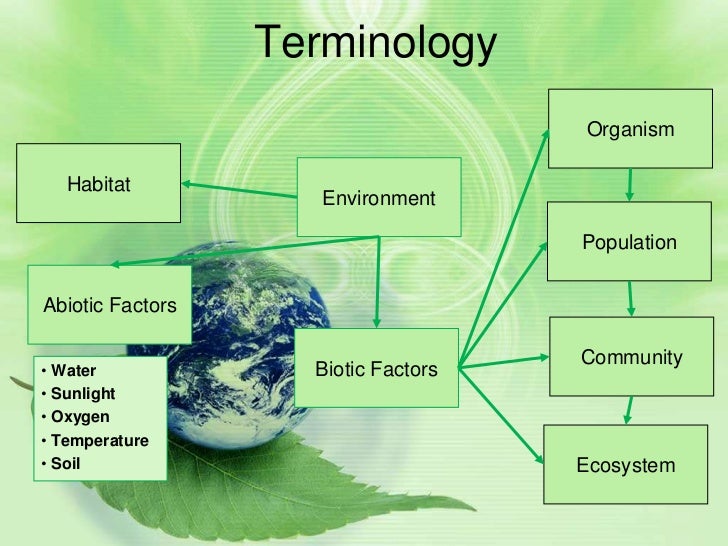
5.1.1 Define species, habitat, population, community, ecosystem and ecology
Species is a group of organisms that can interbreed and produce fertile, viable offspring
Habitat is an environment in which a species normally lives or the location of a living organism
Population is a group of organism of the same species who live in the same area at the same time
Community is a group of populations living and interacting with each other in an area
Ecosystem is a community and its abiotic environment
Ecology is the study of relationships between living organisms and between organisms and their environment.

5.1.2 Distinguish between autotroph and heterotroph
Autotroph is an organism that synthesizes its organic molecules from simple inorganic substances such as carbon dioxide and nitrates. Autotroph are producers.
Heterotroph is an organism that obtains organic molecules from other organisms. Heterotroph are consumers.

5.1.3 Distinguish between consumers, detritivores and saprotrophs
Consumers is an organism that ingests other organic matter that is living or recently killed
Detritivore is an organism that ingest non-living organic matter
Saprotroph is an organism that lives on or in non-living organic matter, secreting digestive enzymes into and absorbing products of digestion

5.1.4 Describe what is meant by a food chain, giving three examples, each with at least three linkages (four organisms)
A food chain shows the linear feeding relationship between species in a community. An arrow is commonly used to represent the transfer of energy. Thus the arrow is pointing towards the consumer.

5.1.5 Describe what is meant by a food web
A food web is a diagram that shows multiple food chains together. It shows a more complete and complex feeding relationships within a community.

5.1.6 Define trophic level
An organisms trophic level refers to the position they are in on the food chain. Refer to the diagram below.

5.1.7 Deduce the trophic level of organisms in a food chain and a food web
An organism can have multiple trophic level. Find the trophic levels by counting how many past

5.1.8 Construct a food web containing up to 10 organisms, using appropriate information
5.1.9 State that light is the initial energy source for almost all communities
5.1.10 Explain the energy flow in a food chain
5.1.11 State that energy transformations are never 100% efficient
5.1.12 Explain reasons for the shape of pyramids of energy
5.1.13 Explain that energy enters and leaves ecosystems, but nutrients must be recycled
5.1.14 State that saprotrophic bacteria and fungi (decomposers) recycle nutrients
Species is a group of organisms that can interbreed and produce fertile, viable offspring
Habitat is an environment in which a species normally lives or the location of a living organism
Population is a group of organism of the same species who live in the same area at the same time
Community is a group of populations living and interacting with each other in an area
Ecosystem is a community and its abiotic environment
Ecology is the study of relationships between living organisms and between organisms and their environment.
5.1.2 Distinguish between autotroph and heterotroph
Autotroph is an organism that synthesizes its organic molecules from simple inorganic substances such as carbon dioxide and nitrates. Autotroph are producers.
Heterotroph is an organism that obtains organic molecules from other organisms. Heterotroph are consumers.

5.1.3 Distinguish between consumers, detritivores and saprotrophs
Consumers is an organism that ingests other organic matter that is living or recently killed
Detritivore is an organism that ingest non-living organic matter
Saprotroph is an organism that lives on or in non-living organic matter, secreting digestive enzymes into and absorbing products of digestion
5.1.4 Describe what is meant by a food chain, giving three examples, each with at least three linkages (four organisms)
A food chain shows the linear feeding relationship between species in a community. An arrow is commonly used to represent the transfer of energy. Thus the arrow is pointing towards the consumer.

5.1.5 Describe what is meant by a food web
A food web is a diagram that shows multiple food chains together. It shows a more complete and complex feeding relationships within a community.

5.1.6 Define trophic level
An organisms trophic level refers to the position they are in on the food chain. Refer to the diagram below.

5.1.7 Deduce the trophic level of organisms in a food chain and a food web
An organism can have multiple trophic level. Find the trophic levels by counting how many past

5.1.8 Construct a food web containing up to 10 organisms, using appropriate information
5.1.9 State that light is the initial energy source for almost all communities
5.1.10 Explain the energy flow in a food chain
5.1.11 State that energy transformations are never 100% efficient
5.1.12 Explain reasons for the shape of pyramids of energy
5.1.13 Explain that energy enters and leaves ecosystems, but nutrients must be recycled
5.1.14 State that saprotrophic bacteria and fungi (decomposers) recycle nutrients
Topic 5: Ecology and evolution
Topic 5 of the IB SL Biology syllabus is the Ecology and evolution. IBO recommends to spend 16 hours on this topic.
This topic has 5 sub-chapters: "Communities and ecosystems", "The greenhouse effect", "Populations", "Evolution", and "Classification". Each are separated with numerical values in order of mentioned.
These are all SL syllabus statements, it is recommended to bring a Casio Graphical Calculator instead of Texas.
This topic has 5 sub-chapters: "Communities and ecosystems", "The greenhouse effect", "Populations", "Evolution", and "Classification". Each are separated with numerical values in order of mentioned.
These are all SL syllabus statements, it is recommended to bring a Casio Graphical Calculator instead of Texas.
訂閱:
意見 (Atom)