6.1.1 Explain why digestion of large food molecules is essential.
Most food is solid and in the form of large complex molecules which are insoluble and chemically inert (not readily stable)
Large molecules need to be broken down into smaller molecules that can be readily absorbed across membranes and into cells. Small molecules can be reassembled into new products (e.g. amino acids can be reassembled to form new proteins).
6.1.2 Explain the need for enzymes in digestion
Enzymes are biological catalysts that speeds up the rate of reaction. It allows reactions to take place at body temperatures. They are specific for a certain type of reaction though based on the lock and key model.
6.1.3 State the source, substrate, products and optimum pH conditions for one amylase, one protease and one lipase
Amylase
Example - Salivary amylase
Source - Salivary glands
Substrate - Starch
Product - Maltose
Optimum pH - 7
Protease
Example - Pepsin
Source - Gastric juice
Substrate - Protein
Product - Short polypeptides
Optimum pH - 2
Lipase
Example - Pancreatic juice
Source - Pancreas
Substrate - Lipids (triglyceride)
Product - Glycerol and fatty acids
Optimum pH - 8
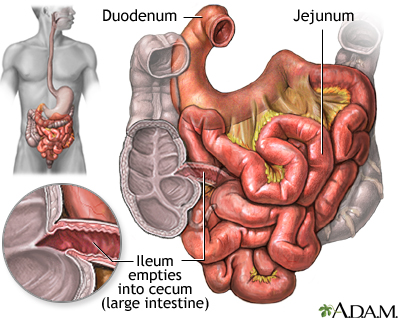
6.1.4 Draw and label a diagram of the digestive system
6.1.5 Outline the function of the stomach, small intestine and large intestine
Stomach
Present in the wall of the stomach are millions of tiny pits called gastric glands which secrete the components of gastric juice. This juice includes hydrochloric acid - sufficiently acidic to create an environment of pH 1.5-2.0, which is the optimum pH for protein digestion by the protease enzymes of the gastric juice. These proteases, of which pepsi is one, are formed in cells of gastric glands and secreted in an inactive state. The hydrochloric acid then activates them, and kills most of the in coming bacteria in the food.
The whole stomach lining is supplied with goblet cells that secrete mucus. Mucus bathes the interior lining of the stomach, forming an effective barrier to both the hydrochloric acid and the protease of the gastric juices, preventing autolysis (self-digestion) of the stomach wall.
As the food is mixed with gastric juice and churned by muscle action it becomes a semi-liquid called chyme. The churning action of the stomach is an important part of the mechanical digestion process. A typical meal may spend up to four hours in the stomach.
Small intestines
Food enters the first part of the small intestine (known as the duodenum) a little at a time. Here the chyme meets bile from the bile duct, and the pancreatic juice from the pancreas. Bile is strongly alkaline and neutralises the acidity of the chyme. It also lowers the surface tension of large fat globules, causing them to break into tiny droplets, a process called emulsification. This speeds digestion by the enzyme lipase later on. Bile itself contains no enzyme.
All these enzymes act as the chyme, bile and pancreatic juice are mixed together by a churning action (a form of peristalsis) called segmentation.
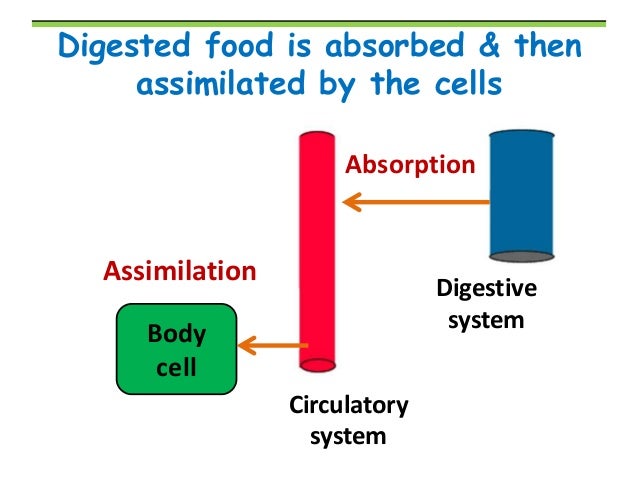
6.1.6 Distinguish between absorption and assimilation
Absorption can be defined as the movement of particles or dissolved substances across a membrane
Assimilation can be defined as the conversion of nutrients into fluids or solid parts of an organism.
6.1.7 Explain how the structure of the villus is related to its role in absorption and transport of the products of digestion
There are different structure of the villus which aid its role in absorption.
Micro-villi is present to provide a huge surface area for absorption.
Epithelium cells has a single layer of small cells, packed with mitochondria - the source of ATP for active uptake across the plasma membrane.
Protein pumps in the plasma membrane of the epithelial cells can actively transport nutrients across the plasma membrane into the villi
There is also a big network of capillaries which proved a large surface area for uptake of amino acids, monosaccharides, and fatty acids and glycerol into blood circulation.
Lacteal is a branch of the lymphatic system into which triglycerides (combined with protein) pass for transport to body cells
The mucus from goblet cells in the epithelium can lubricate movement of digested food among the villi and protects plasma membrane of epithelial cells.
2014年6月9日 星期一
Topic 6: Human health and physiology
Topic 6 of the IB SL Biology syllabus is the Human health and physiology. IBO recommends to spend 20 hours on this topic.
This topic has 6 sub-chapters: "Digestion", "The transport system", "Defense against infectious defense", "Gas exchange", "Nerves, hormones and homeostasis" and "Reproduction". Each are separated with numerical values in order of mentioned.
These are all SL syllabus statements, it is recommended to bring a Casio Graphical Calculator instead of Texas.
2014年4月13日 星期日
Topic 10.3: Polygenic inheritance
10.3.1 Define polygenic inheritance
Polygenic inheritance refers to a single characteristic that is controlled by more than two genes (also called multifactorial inheritance)
Polygenic inheritance patterns normally (bell-shaped) distribution curve - it shows continuous variation
By increasing the number of genes controlling a trait, the number of phenotype combinations also increase, until the number of phenotypes to which an individual can be assigned are no longer discrete, but continuous
10.3.2 Explain that polygenic inheritance can contribute to continuous variation using two examples, one of which must be human skin colour
Human skin colour
- The colour of human skin is determined by the amount of dark pigment (melanin) it contains
- At least four (possibly more) genes are involved in melanin production; for each gene one allele codes for melanin production, the other does not
- The combination of melanin producing alleles determines the degree of pigmentation, leading to continuous variation
Grain colour in wheat
- Wheat grains vary in colour from white to dark red, depending on the amount of red pigment they contain
- Three genes control the colour and each gene has two alleles (one coding for red pigment, the other coding for no pigment)
- The most frequent combinations have an equal number of "pigment producing" and "no pigment" alleles, whereas combinations of one extreme or the other are relatively rare
- The overall pattern of inheritance shows continuous variation
Topic 10.2: Dihybrid crosses and gene linkage
10.2.1 Calculate and predict the genotypic and phenotypic ratio of offspring of dihybrid crosses involving unlinked autosomal genes
A dihybrid cross determines the allele combinations of offspring for two particular genes that are unlinked (not on the same chromosomes)
Because there are two genes with two alleles per gene (multiple alleles not required), there can be up to four different gamete combinations
10.2.2 Distinguish between autosomes and sex chromosomes
Autosomes: Pairs of chromosomes that are identical in appearance (e.g. same size, same gene loci, etc) and are not involved in sex determination
Sex chromosome: Pairs of chromosomes involved in sex determination and are not identical in appearance (e.g. X and Y chromosome in humans)
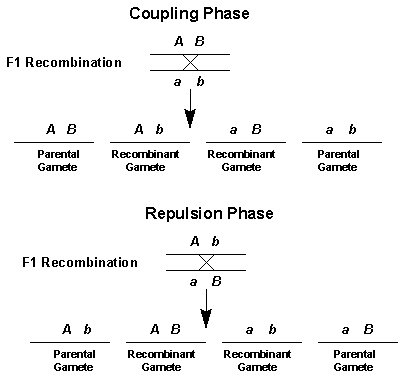
10.2.3 Explain how crossing over between non-sister chromatids of a homologous pair in prophase I can result in an exchange in alleles
During crossing over in prophase I, non-sister chromatids of a homologous pair may break and reform at points of attachment called chiasmata
As these chromatids break at the same point, any gene loci below the point of the break will be exchanged as a result of recombination
This means that maternal and paternal alleles may be exchanged between the maternal and paternal chromosomes, creating new gene combinations
The further apart two gene loci are on a chromosome, the more likely they are to be exchanged
10.2.4 Define linkage group
A linkage group is a group of genes whose loci are on the same chromosome and therefore do not follow the law of independent assortment
Linkage genes will tend to be inherited together - the only way to separate them is through recombination (via crossing over during synapsis)
10.2.5 Explain an example of a cross linkage between two linked genes
When two genes are linked, they do not follow the expected phenotypic ratio for a dihybrid cross between heterozygous parents
Instead the phenotypic ratio will follow that of a monohybrid cross as the two genes are inherited together
This means that offspring will tend to produce the parental phenotypes
Recombinant phenotypes will only be evident if crossing over occurs in prophase I and would thus be expected to appear in low number (if at all)
An example of a cross between two linked genes is the mating of a grey bodied, normal wing fruit fly with a black bodied, vestigial wing mutant
10.2.6 Identify which of the offspring are recombinants in a dihybrid cross involving linked genes
Recombinants of linked genes are those combinations of genes not found in parents
For example, in a test cross of a heterozygous fruit fly (grey bodied, normal wings) with a homozygous recessive mutant (black bodied, vestigial wings), the recombinants would be the grey bodied, vestigial winged offsprings and the black bodied, normal winged offspring
Linked genes that have undergone recombination can be distinguished from unlinked genes via test cross because the frequency of the recombinant genotype will always be less than would occur for unlinked genes (crossing over does not happen every time)
- For example:
- Heterozygous test cross of unlinked genes = 1:1:1:1 phenotypic ratio
- Heterozygous test cross of linked genes = 1:1:0.1:0.1 pehnotypic ratio (uncommon phenotypes are recombinants)
Topic 10.1: Meiosis
10.1.1 Describe the behaviour of the chromosomes in the phases of meiosis
Interphase: Cell growth and DNA replication (duplication of DNA creates sister chromatid chromosome)
Meiosis I
10.1.2 Outline the formation of chiasmata in the process of crossing over
Crossing over involves the exchange of segments of DNA between homologous chromosomes during Prophase I of meiosis
The process of crossing over occurs as follows
10.1.3 Explain how meiosis results in an effectively infinite genetic variety in gametes through crossing over in prophase I and random orientation in metaphase I
During anaphase I, homologous chromosomes separate, such that each resultant daughter (and subsequent gametes) contains a chromosome of either maternal or paternal origin
The orientation of these homologous in metaphase I is random, such that there is an equal probability of the daughter cell having either the maternal or paternal chromosome
As humans have a haploid number of 23 chromosomes, this means that there is 223 potential gamete combinations (over 8 million combinations)
Crossing over in prophase I results in entirely new chromosome combinations, as recombination through gene exchange produces wholly original chromosomes containing both maternal and paternal DNA, resulting in near infinite genetic variability
Other sources of genetic variation include random fertilisations, DNA mutations, chromosome mutations and non-disjunction
10.1.4 State Mendal's law of independent assortment
Gregor Mendal was a 19th century Moravian monk who demonstrated that the inheritance of traits (i.e. genes) followed particular laws:
10.1.5 Explain the relationship between Mendal's law of independent assortment and meiosis
The law of independent assortment relates to the random orientation of homologous chromosomes in metaphase I of meiosis
Because the orientation of a homologous pair is random, and does not affect the orientation of any other homologous pair, any one of a pair of alleles on a chromosome has an equal chance of being paired with, or separated from, any one of a pair of alleles on another chromosome
This means the inheritance of two different traits will occur independently of each other (provided the genes aren't linked)
Interphase: Cell growth and DNA replication (duplication of DNA creates sister chromatid chromosome)
Meiosis I
- Prophase I: DNA supercoils and chromosomes condense, nuclear membrane dissolves, homologous pairs form bivalents, crossing over occurs
- Metaphase I: Spindle fibres from centrioles (at poles) attach to centromeres of bivalent, bivalents line up along the equator of the cell
- Anaphase I: Spindle fibres contract and split the bivalent, homologous chromosomes move to opposite poles of the cell
- Telophase I: Chromosomes decondense, nuclear membranes may reform, cell divide (cytokinesis) forming two haploid daughters cells
Interkinesis: An optional rest period between meiosis I and meiosis II, no DNA replication occurs in this stage
Meiosis II
- Prophase II: Chromosomes condense, nuclear membrane dissolves (if reformed), centrioles move to opposite poles (perpendicular to previous poles)
- Metaphase II: Spindle fibres form centrioles attach to centromeres of chromosomes, chromosomes line up along the equator of the cell
- Anaphase II: Spindle fibres contract and split the chromosome into sister chromatids, chromatids (now called chromosomes) move to opposite poles
- Telophase II: Chromosomes decondense, nuclear membrane reforms, cells divide (cytokinesis), resulting in four haploid daughter cells
10.1.2 Outline the formation of chiasmata in the process of crossing over
Crossing over involves the exchange of segments of DNA between homologous chromosomes during Prophase I of meiosis
The process of crossing over occurs as follows
- Homologous chromosomes become connected in a process called synapsis, forming a bivalent (or tetrad)
- Non-sister chromatids break and recombine with their homologous partner, effectively exchanging genetic material (crossing over)
- The non-sister chromatids remain connected in an X-shaped structure and the positions of attachment are called chiasmata
Chiasmata hold homologous chromosomes together as a bivalent until anaphase I
As a result of crossing over, chromatids may consist of a combination of DNA derived from both homologous - these are called recombinant
10.1.3 Explain how meiosis results in an effectively infinite genetic variety in gametes through crossing over in prophase I and random orientation in metaphase I
During anaphase I, homologous chromosomes separate, such that each resultant daughter (and subsequent gametes) contains a chromosome of either maternal or paternal origin
The orientation of these homologous in metaphase I is random, such that there is an equal probability of the daughter cell having either the maternal or paternal chromosome
As humans have a haploid number of 23 chromosomes, this means that there is 223 potential gamete combinations (over 8 million combinations)
Crossing over in prophase I results in entirely new chromosome combinations, as recombination through gene exchange produces wholly original chromosomes containing both maternal and paternal DNA, resulting in near infinite genetic variability
Other sources of genetic variation include random fertilisations, DNA mutations, chromosome mutations and non-disjunction
10.1.4 State Mendal's law of independent assortment
Gregor Mendal was a 19th century Moravian monk who demonstrated that the inheritance of traits (i.e. genes) followed particular laws:
- Law of segregation: Each herediatary characteristics is controlled by two alleles, which segregate and pass into different reproductive cells (gametes)
- Law of independent assortment: The separation of alleles for one gene will occur independently of the separation of alleles for another gene
- According to the law of independent assortment, different allele combinations should always be equally impossible
- However this law only holds for genes that are on different chromosomes - the law of independent assortment does not apply to linked genes
10.1.5 Explain the relationship between Mendal's law of independent assortment and meiosis
The law of independent assortment relates to the random orientation of homologous chromosomes in metaphase I of meiosis
Because the orientation of a homologous pair is random, and does not affect the orientation of any other homologous pair, any one of a pair of alleles on a chromosome has an equal chance of being paired with, or separated from, any one of a pair of alleles on another chromosome
This means the inheritance of two different traits will occur independently of each other (provided the genes aren't linked)
Topic 10: Genetics
Topic 10 of the IB HL Biology syllabus is the Genetics. IBO recommends to spend 6 hours on this topic.
This topic has 3 sub-chapters: "Meiosis", "Dihybrid crosses and gene linkage" and "Polygenic inheritance". Each are separated with numerical values in order of mentioned.
These are all HL syllabus statements, it is recommended to bring a Casio Graphical Calculator instead of Texas.
This topic has 3 sub-chapters: "Meiosis", "Dihybrid crosses and gene linkage" and "Polygenic inheritance". Each are separated with numerical values in order of mentioned.
These are all HL syllabus statements, it is recommended to bring a Casio Graphical Calculator instead of Texas.
2014年3月28日 星期五
Topic 4.4: Genetic engineering and biotechnology
4.4.1 Outline the use of polymerase chain reaction (PCR) to copy and amplify minute quantities of DNA
PCR is a way of producing large quantities of a specific target sequences of DNA
It is useful when only a small amount of DNA is available for testing
PCR occurs in a thermal cycler and involves a repeat procedure of 3 steps:
4.4.2 State that, in gel electrophoresis, fragments of DNA move in an electric field and are separated according to their size.
Gel electrophoresis is a technique which is used to separate fragments of DNA according in size
4.4.3 State that get electrophoresis of DNA is used in DNA profiling.
DNA profiling is a technique by which individuals are identified on the basis of their respective DNA profiles
Within the non-coding region of an individual's genome, there exists satellite DNA - long stretches of DNA made up of repeating elements called short tandem repeats (STRs)
These repeating sequences can be existed to form fragments, by cutting with a variety of restriction endonucleases (which cut DNA at specific sites)
As individuals all have a different number of repeats in a given sequence of satellite DNA, they will all generate unique fragment profiles
These different profiles can be compared using gel electrophoresis
4.4.4 Describe the application of DNA profiling to determine paternity and also in forensic investigations.
A DNA sample is collected (blood, saliva, semen, etc) and amplied using PCR
Satellite DNA (non-coding) is cut with specific restriction enzymes to generate fragments
Individuals will have unique fragment lengths due to the variable length of their short tandem repeats (STR)
The fragments are separated with gel electrophoresis (smaller fragments move quickers through the gel)
The DNA profile can then be analysed according to need
Two applications of DNA profiling are:
4.4.5 Analyse DNA profiles to draw conclusions about paternity or forensic investigations
Paternity testing: Children inherit half of their alleles from each parent and thus should possess a combination of their parents alleles
Forensic investigation: Suspect DNA should be a complete match with the sample taken from a crime scene if a conviction is to occur
4.4.6 Outline three outcomes of the sequencing of the complete human genome
The human genome project (HGP) was an international cooperative venture established to sequence the 3 billion base pair (~25,000 genes) in the human genome
The outcomes of this project include:
4.4.7 State that, when genes are transferred between species, the amino acid sequence of polypeptides translated from them is unchanged because the genetic code is universal.
The genetic code is universal, meaning that for every living organism the same codons code for the same amino acids (there are few rare exceptions)
This means that the genetic information from one organism could be translated by another (i.e. it is theoretically transferable)
4.4.8 Outline a basic technique used for gene transfer involving plasmids, a host cell (bacterium, yeast or other cell), restriction enzymes (endonucleases) and DNA ligase
1. DNA Extraction
4.4.9 State two examples of the current uses of genetically modified crops or animals
Crops
4.4.10 Discuss the potential benefits and possible harmful effects of one example of genetic modification
Potential benefits
4.4.11 Define clone
A clone is a group of genetically identical organisms or a group cells derived from a single parent cells
4.4.12 Outline a technique for cloning using differentiated animal cells
Somatic cell nucleus transfer (SCNT) is a method of reproductive cloning using differentiated animal cells
4.4.13 Discuss the ethical issues of therapeutic cloning in humans.
Arguments for therapuetic cloning
PCR is a way of producing large quantities of a specific target sequences of DNA
It is useful when only a small amount of DNA is available for testing
PCR occurs in a thermal cycler and involves a repeat procedure of 3 steps:
- Denaturation: DNA sample is heated to separate it into two strands
- Annealing: DNA primers attached to opposite ends of the target sequences
- Elongation: A heat-tolerant DNA polymerase (Taq) copies the strand
One cycle of PCR yields two identical copies the DNA sequences
4.4.2 State that, in gel electrophoresis, fragments of DNA move in an electric field and are separated according to their size.
Gel electrophoresis is a technique which is used to separate fragments of DNA according in size
- Samples of fragmented DNA are placed in the wells of an agarose gel
- The gel is placed in a buffering solution and an electrical current is passed across the gel
- DNA, being negatively charged (due to phosphate), moves to the positive terminus (anode)
- Smaller fragments are less impeded by the gel matrix and move faster through the gel
- The fragments are thus separated according to size
- Size can be calculated (in kilobases) by comparing against a known industry standard
4.4.3 State that get electrophoresis of DNA is used in DNA profiling.
DNA profiling is a technique by which individuals are identified on the basis of their respective DNA profiles
Within the non-coding region of an individual's genome, there exists satellite DNA - long stretches of DNA made up of repeating elements called short tandem repeats (STRs)
These repeating sequences can be existed to form fragments, by cutting with a variety of restriction endonucleases (which cut DNA at specific sites)
As individuals all have a different number of repeats in a given sequence of satellite DNA, they will all generate unique fragment profiles
These different profiles can be compared using gel electrophoresis
4.4.4 Describe the application of DNA profiling to determine paternity and also in forensic investigations.
A DNA sample is collected (blood, saliva, semen, etc) and amplied using PCR
Satellite DNA (non-coding) is cut with specific restriction enzymes to generate fragments
Individuals will have unique fragment lengths due to the variable length of their short tandem repeats (STR)
The fragments are separated with gel electrophoresis (smaller fragments move quickers through the gel)
The DNA profile can then be analysed according to need
Two applications of DNA profiling are:
- Paternity testing (comparing DNA of offspring against potential fathers)
- Forensic investigation (identifying suspects or victims based on crime-scene DNA)
4.4.5 Analyse DNA profiles to draw conclusions about paternity or forensic investigations
Paternity testing: Children inherit half of their alleles from each parent and thus should possess a combination of their parents alleles
Forensic investigation: Suspect DNA should be a complete match with the sample taken from a crime scene if a conviction is to occur
4.4.6 Outline three outcomes of the sequencing of the complete human genome
The human genome project (HGP) was an international cooperative venture established to sequence the 3 billion base pair (~25,000 genes) in the human genome
The outcomes of this project include:
- Mapping: We now know the number, location and basic sequence of human genes
- Screening: This has allowed for the production of specific gene probes to detect sufferers and carriers of genetic disease conditions
- Medicine: With the discovery of new proteins and their functions, we can develop improved treatments (pharmacogenetics and rational drug design)
- Ancestry: It will give us improved insight into the origins, evolution and historical migratory patterns of humans
With the completion of the Human Genome Project in 2003, researcher have begun to sequence the genomes of several non-human organisms
4.4.7 State that, when genes are transferred between species, the amino acid sequence of polypeptides translated from them is unchanged because the genetic code is universal.
The genetic code is universal, meaning that for every living organism the same codons code for the same amino acids (there are few rare exceptions)
This means that the genetic information from one organism could be translated by another (i.e. it is theoretically transferable)
4.4.8 Outline a basic technique used for gene transfer involving plasmids, a host cell (bacterium, yeast or other cell), restriction enzymes (endonucleases) and DNA ligase
1. DNA Extraction
- A plasmid is removed from a bacterial cell (plasmids are small, circular DNA molecules that can exist and replicate autonomously)
- A gene of interest is removed from an organism's genome using a restriction endonuclease which cut at specific sequences of DNA
- The gene of interest and plasmid are both amplified using PCR technology
2. Digestion and Ligation
- The plasmid is cut with the same restriction enzyme that was used to excise the gene of interest
- Cutting with certain restriction enzymes may generate short sequences overhangs ("sticky ends") that allow the two DNA constructs to fit together
- The gene of interest and plasmid are spliced together by DNA ligase creating a recombinant plasmid
3. Transfection and Expression
- The recombinant plasmid is inserted into the desired host cells (this is called transfection for eukaryotic cells and transformation for prokaryotic cells)
- The transgenic cell will hopefully produce the desired trait encoded by the gene of interest (expression)
- The product may need to subsequently be isolated from the host and purified in order to generate sufficient yield
4.4.9 State two examples of the current uses of genetically modified crops or animals
Crops
- Engineering crops to extend shelf life of fresh produce
- Tomatoes (Flavr Savr) have been engineered to have an extended keeping quality by switching off the gene for ripening and thus delaying the natural process of softening the fruit
- Engineering of crops to provide protection from insects
- Maize crops (Bt corn) have been engineered to be toxic to the corn borer by introducing a toxin gene from a bacterium
Animals
- Engineering animals to enhance production
- Sheep produce more wool when engineered with the gene for the enzyme responsible for the production of cystesine - the main amino acid in the keratin protein of wool
- Engineering animals to produce desired products
- Sheep engineered to produce human alpha-1-antitrypsin in their milk can be used to help treat individuals suffering from hereditary emphysema
4.4.10 Discuss the potential benefits and possible harmful effects of one example of genetic modification
Potential benefits
- Allows for the introduction of a characteristic that wasn't present within the gene pool (selective breeding could not have produced desired phenotype)
- Results in increased productivity of food production (require less land for comparable yield)
- Less use of chemical pesticides, reducing the economic cost of farming
- Can now grow in regions that, previously, may not have been viable (reduces need for deforestation)
Potential harmful effects
- Could have currently unknown harmful effects (e.g. toxin may cause allergic reactions in a percentage of the population)
- Accidental release of transgenic organism into the environment may result in competition with native plant species
- Possibility of cross pollination (if gene crosses the species barrier and is introduced to weeds, may have a hard time controlling weed growth)
- Reduces genetic variation / biodiversity (corn borer may play a crucial role in local ecosystem
4.4.11 Define clone
A clone is a group of genetically identical organisms or a group cells derived from a single parent cells
4.4.12 Outline a technique for cloning using differentiated animal cells
Somatic cell nucleus transfer (SCNT) is a method of reproductive cloning using differentiated animal cells
- A female animal (e.g. sheep) is treated with hormones (such as FSH) to stimulate the development of eggs
- The nucleus from an egg cell is removed (enucleated), thereby removing the genetic information form the cell
- The egg cell is fused with the nucleus from a somatic (body) cell of another sheep, making the egg cell diploid
- An electric shock is delivered to stimulate the egg to divide, and once this process has begun the egg is implanted into the uterus of a surrogate
- The developing embryo will have the same genetic material as the sheep that contributed the diploid nucleus, and thus be a clone
4.4.13 Discuss the ethical issues of therapeutic cloning in humans.
Arguments for therapuetic cloning
- May be used to cure serious diseases or disabilities with cell therapy (replacing bad cells with good ones)
- Stem cells research may pave way for future discoveries and beneficial technologies that would not have occurred if their use had been banned
- Stem cells can be taken from embryos that have stopped developing and would have died anyways (e.g. abortions)
- Cells are taken at a stage when the embryo has no nervous system and can arguably feel no pain
Arguments against therapeutic cloning
- Involves the creation and destruction of human embryos (at what point do we afford the right to life?)
- Embryonic stem cells are capable of continued division and may develop into cancerous cells and cause tumors
- More embryos are generally produced than are needed, so excess embryos are killed
- With additional cost and effort, alternative technologies may fulfill similar roles (e.g. nuclear reprogramming of differentiated cell lines)
訂閱:
文章 (Atom)