2014年3月25日 星期二

Topic 7.5: Proteins

7.5.1 Explain the four levels of protein structure, indicating the significance of each level.

There are four levels of protein sturcture; primary, secondary, tertiary and quaternary level.

Primary:

Simple linked amino acids bonded together through peptide bonds. The amino acids are defined by their side chain (R group). Most polypeptide are 50-1000 amino acids long. The protein is read from the amino group (NH2) to the carboxyl group (COOH).


Secondary:

Alpha-helix:
The alpha helix is formed from hydrogen bonds and are often the basis of fibrous protein.

Beta-pleated sheets:

The polpeptide chain is much more stretched out in comparison to the alpha helix. This "sheet" has twists which increases the strength and rigidity of the structure.


Tertiary:

Tertiary structures contain a combination of alpha helicies and beta-pleated sheets. It is held together in that particular shape through a series of different forces of attraction, which include; Hydrogen bond, Van der Waal's forces, disulphide bond and ionic bond.


Quaternary:

The quaternary structure of protein arises when two or more proteins become held together, forming a complex, biologically active molecule. An example is haemoglobin, consisting of four polypeptide chains held around a non-protein haem group.


7.5.2 Outline the difference between fibrous and globular proteins, with references to two examples of each protein type.


7.5.3 Explain the significance of polar and non-polar amino acids.

Polar amino acid have hydrophilic R groups, whereas non-polar amino acids have hydrophobic R groups

For water-soluble proteins, non-polar amino acids tend to be found in the centre of the protein (stabilizing structure) while polar amino acids are found on the surface (capable of interacting with water molecule)

For membrane-bound proteins, non-polar amino acids tend to be localised on the surface in contact with the membrane, while polar amino acids line interior pores (to create hydrophilic channel)

For enzyme, the active site specifically depends on the location and distribution of polar and non-polar amino acids as hydrophobic and hydrophilic interaction can play a role in substrate binding to the active site.


7.5.4 State four functions of protein, giving a named example for each.

Great way to remember different functions (SHIT ME)

Structure: Support for body tissues (Collagen, Elastin or Keratin)
Hormones: Regulation of homoestatis (Insulin or Glucagon)
Immunity: Bind antigens (Antibodies or immunoglobulins)
Transport: Movement of substrates (Haemoglobin, myoglobin)

Movement: Muscle contraction (actin/myosin, troponin/tropomysin)
Enzyme: Speeding up metabolic reaction (catalase, lipase, pepsin)


Topic 7.4: Translation

7.4.1 Explain that each tRNA molecule is recognized by a tRNA-activating enzyme that binds a specific amino acid to the tRNA, using ATP for energy

Each different tRNA molecule has a unique shape and chemical composition that is recognised by a specific tRNA-activating enzyme. Each amino acid has its own tRNA with a unique anti-codon.

The amino acid is bound to the tRNA in a two step process catalysed by its own tRNA-activating enzyme

  • The amino acid will react will ATP and become activated. The ATP lose its energy in this process
  • The activated amino acid will then bind to the acceptor stem of its own tRNA


7.4.2 Outline the structure of ribosome, including protein and RNA composition, large and small subunits, three tRNA binding sites and mRNA binding sites

All ribosomes are made of protein and ribosomal RNA (rRNA). The nucleolus contains (many copies of) the information on how to make rRNA. Ribosomes consists of two subunits, a small and a large unit.

The smaller subunit is made of one molecule of rRNA and some proteins, the larger subunit is made of two molecules of rRNA and some proteins, including the enzyme peptidyl transferase which links together the amino acids brought in by tRNA. The smaller subunit has the binding site for mRNA, the larger subunit has the binding sites (known as the A, P and E sites) for tRNA.


7.4.3 State that translation consists of initiation, elongation, translocation and termination

Translation occurs in four main steps

  • Initiation involves the assembly of an active ribosomal complex
  • Elongation involves new amino acids brought to the ribosome according to the codon sequence
  • Translocation involves amino acids translocated to a growing polypeptide chain
  • Termination involves a "stop" codon, when the translation ends and the polypeptide is released.


7.4.4 State that translation occurs in a 5' - 3' direction

The start codon (AUG) is located at the 5' end of the mRNA sequence and the ribosome moves along it in the 3' direction. Therefore, the translation process occurs in the 5' - 3' direction.


7.4.5 Draw and label a diagram showing the structure of a peptide bond between two amino acids


This is how you draw the link between two protein. It is important to put the R group to show there could be a variety of proteins. As shown more accurately in this diagram.


If you managed to do it correctly, here have a cookie


7.4.6 Explain the process of translation, including ribosomes, polysomes, start codons and stop codons

Pre-initiation

  • Specific tRNA-activation enzymes catalyse the attachment of amino acids to tRNA molecules, using ATP for energy
Initiation
  • The small ribosomal subunit binds to the 5' end of mRNA and moves along it until it reaches the start codon (AUG)
  • Next, the appropriate tRNA molecule binds to the codon via its anticodon (according to complementary base pairing)
  • Finally, the large ribosomal subunit aligns itself to the tRNA molecule at its P-site and forms a complex with the small ribosomal subunit


Elongation

  • A second tRNA molecule pairs with the next codon in the ribomsomal A-site
  • The amino acid in the P-site is covalently attached via peptide bond to the amino acid in the A-site


Translocation

  • The ribosome moves along one codon position, the deacylated tRNA moves into the E-site and is released, while the tRNA bearing the dipeptide moves into the P-site
  • Another tRNA molecule attaches to the next codon in the newly emptied A-site and the process is repeated
  • Multiple ribosomes can translate a single mRNA sequence simultaneously (forming polysomes)


Termination

  • Elongation and translocation continues until the ribosome reaches a stop codon
  • These codons do not code for any amino acids and instead signal for translation to stop
  • The polypeptide is released and the ribosome disassembles back into subunits
  • The polypeptide may undergo post-translational modification prior to becoming a functional protein

This diagram shows the overall process of translation


7.4.7 State that free ribosomes synthesize proteins for use primarily within the cell, and that bound ribosomes synthesize proteins primarily for secretion or for lysosome.

Ribosomes floating freely in the cytosol produce proteins for use within the cell. However ribosomes are also attached to the rough endoplasmic reticulum to produce proteins to be exported from the cell or used in the lysosome.


Topic 7.3: Transcription

7.3.1 State that transcription is carried out in a 5' - 3' direction.

Transcription is also carried out in a 5' - 3' direction.


It is also important to note that only one strand of DNA will be required in the process of transcription.


7.3.2 Distinguish between the sense and antisense strands in DNA

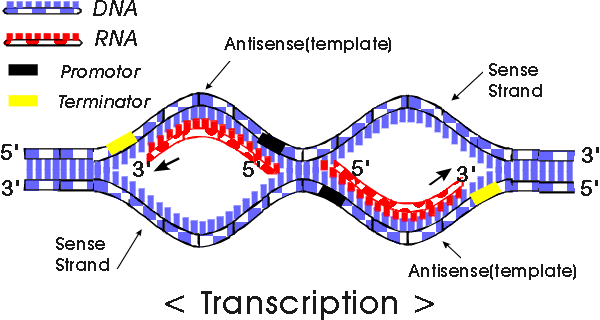
Sense strand is not transcribed into RNA, its sequence will be the "DNA version" of the mRNA sequence.

Antisense strand is transcribed into the RNA, its sequence will be the "DNA version" of the tRNA anticodon sequence


7.3.3 Explain the process in transcription in prokaryotes, including the role of the promoter region, RNA polymerase, nucleoside triphosphate and the terminator

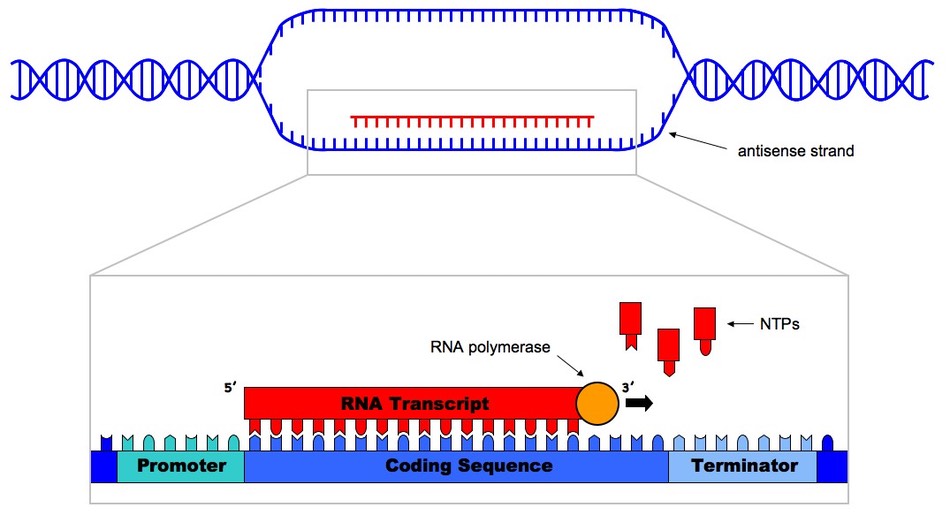
This is what transcription should look like.


The promoter is responsible for the initiation of transcription (in prokaryotes, a number of genes may be regulated by a single promoter). While the terminator is responsible for terminating the transcription. However this differs between prokaryotes and eukaryotes.

Process

  • RNA binds to the promoter region
  • Initiates transcription
  • RNA polymerase uncoils the DNA
  • Only one strand is used, the anti-sense strand
  • Free nucleoside triphosphate bond to their complementary bases on the anti-sense strand
  • Uracil replaces Thymine
  • As the nucleoside triphosphates bind, they become nucleotides and release energy to form the phosphodiester bond by losing the two phosphate groups
  • The mRNA is built in a 5' - 3' direction
  • RNA polymerase forms covalent bonds between the nucleotides and keeps moving along the DNA until it reaches the terminator
  • The terminator signals the RNA polymerase to stop transcription
  • RNA polymerase is released and the mRNA separates from the DNA
  • DNA rewinds


7.3.4 State that eukaryotic RNA needs the removal of introns to form mature mRNA

Pre-mRNA has been produced through transcription of the anti-sense strand as described for prokaryotic transcription.

Introns are broken down in the nucleus and the remaining exons are called the mature mRNA. Which is then exported from the nucleus to the cytoplasm for translation into a polypeptide


Topic 7.2: DNA replication

7.2.1 State that DNA replication occurs in a 5' to 3' direction

DNA replication is a semi-conservative process, this means that a new strand is synthesised from an original template strand. The free nucleotide 5' end is bonded covalently to the 3' end which is on the already formed polynucleotide.


The 5C joins with the 3C, hence 5' to 3'.


7.2.2 Explain the process of DNA replication in prokaryotes, including the role of enzyme (helicase, DNA polymerase, RNA primase and DNA ligase), Okazaki fragments and deoxynucleoside triphosphates.

Helicase unwinds and separates the double stranded DNA by breaking the hydrogen bonds between the base pairs. This occurs at specific regions creating a replication fork of two polynucleotide strand in anti-parallel direction.


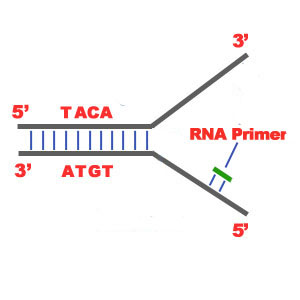
RNA primase synthesises a short RNA primer on each template strand to provide an attachment and initiation point for polymerase III


DNA polymerase III adds deoxynucleoside triphosphates (dNTPs) to the 3' end of the polynucleotide chain, synthesizing in a 5' - 3' direction

The dNTPs pair up with their complementary base pairs and the two additional phosphate releases energy to form a phosphodiester bond. This process continues smoothly on the leading strand (5' - 3') while not so smoothly on the lagging strand (3' - 5')

The lagging strand forms Okazaki fragments. This is because the the dNTPs must join from the direction of 5' - 3', thus the DNA polymerase III must work backwards towards the origin.


DNA polymerase I removes the RNA primers and replaces them with DNA.

DNA ligase joins the okazaki fragments together to form a continuous strand.


7.2.3 State that DNA replication is initiated at many points in a eukaryotic chromosomes


Eukaryotic genomes are typically larger than prokaryotic genomes, DNA replication is initiated at many points simultaneously in order to limit the time required for DNA replication to occur.

It is mainly used to get the work done faster.


Topic 7.1: DNA structure

7.1.1 Describe the structure of DNA, including the anti-parallel strands, 3'-5' linkages and hydrogen bonds between purines and pyrimidines

DNA

DNA has a double stranded helix which has uniform diameter along its entire length. The two polynucleotide strands are "anti-parallel", they run in opposite direction.


The hydrogen-bonding is specific and known as complementary base pairing. Adenine and Thymine are double hydrogen bonded while Cytosine and Guanine are triple hydrogen bonded.

Purines are double ringed nucleotides; Adenine and Guanine
Pyrimidine are single ringed nucleotides; Cytosine and Thymine


7.1.2 Outline the structure of nucleosomes

The double helix has a lot of major and minor grooves on its outer diameter, this exposes chemical groups to form hydrogen bond with it.


The DNA is bonded to 8 histone molecules (2 x 2 x 2). The combination of DNA and histones is secured by the "H1 linker" protein.


7.1.3 State that nucleosomes help to supercoil chromosomes and help to regulate transcription

Nucleosomes

  • Protect DNA from damage
  • They allow long lengths of DNA to be packaged (super-coiled) for mobility during meiosis/mitosis
  • However when super-coiled, the DNA is not accessible for transcription
  • It condenses the DNA to by a factor of 15000x


7.1.4 Distinguish between unique or single-copy genes and highly repetitive sequences in nuclear DNA


7.1.5 State that eukaryotic genes can contain exons and introns

Exons are the part of the gene which codes for a protein (EXpressing sequence)

Introns are the non-coding sequence of DNA within a gene (INtervening sequence) that is cut out by enzymes when RNA is made into mature mRNA


Eukaryotic organism have DNA which differs from prokaryotic organisms.

Topic 7: Nucleic acids and proteins

Topic 7 of the IB HL Biology syllabus is the Nucleic acids and proteins. IBO recommends to spend 11 hours on this topic.

This topic has 6 sub-chapters: "DNA structure", "DNA replication", "Transcription", "Translation", "Proteins" and "Enzymes". Each are separated with numerical values in order of mentioned.

These are all HL syllabus statements, it is recommended to bring a Casio Graphical Calculator instead of Texas.

2013年11月28日 星期四

Topic 3.8: Photosynthesis

3.8.1 State that photosynthesis involves conversion of light energy into chemical energy.

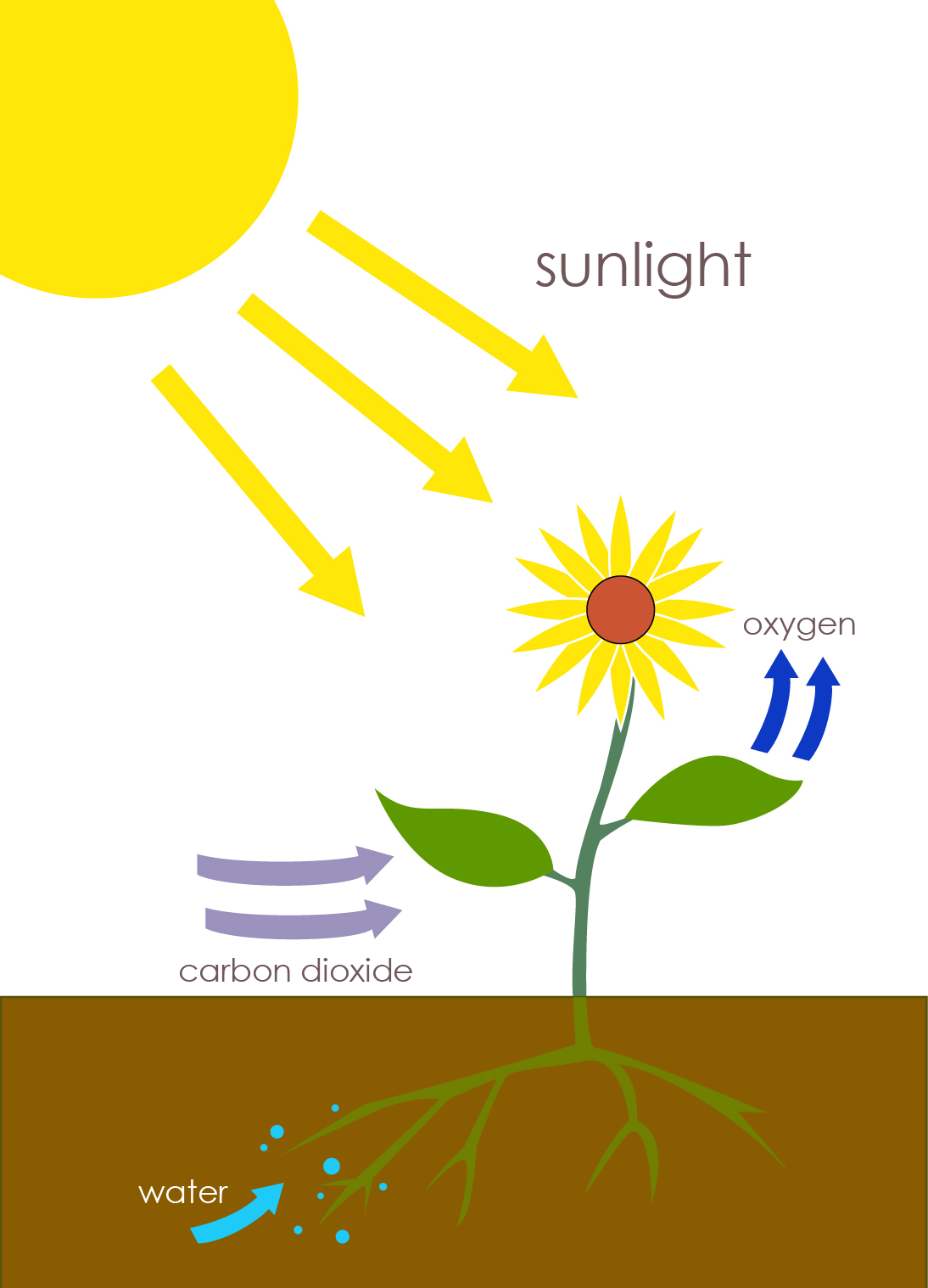
Photosynthesis is the process by which plants synthesis organic compounds (e.g glucose) from inorganic compounds (carbon dioxide and oxygen) in the presence of sunlight


3.8.2 State that light from the Sun is composed of a range of wavelengths (colours).

Light from the sunlight is made up of all the colours of the electro-magnetic spectrum


3.8.3 State that chlorophyll is the main photosynthetic pigment

Chlorophyll is the main site of light absorption in the light dependent stage of photosynthesis. There are a different number of chlorophyll molecule, each with their own distinct absorption spectra.


3.8.4 Outline the differences in absorption of red, blue and green light by the chlorophyll

This is a graph that shows the light absorption spectra


The main colour of light that is absorbed are red and blue. Green is the colour that is mainly reflected. Thus the green colour we can see from the chloroplast. During the winter times, trees produce less chlorophyll as there are less sunlight. Thus the change in colour of leaves during the different season


3.8.5 State that light energy is used to produce ATP, and to split water molecules (photolysis) to form oxygen and hydrogen.

Photosynthesis consists of two reactions; light dependent and light independent.

Light Dependent

  • Light is absorbed by the chlorophyll molecules (green) inside the chloroplast
  • The light energy from the photons (light) is transferred to excite the electrons thus changing the energy from light to chemical
  • The chemical energy is used to produce ATP
  • Light energy also splits the water molecule in a process called photolysis, producing oxygen and hydrogen
  • The hydrogen is taken up by the hydrogen carrier (NADP+) to form NADPH
  • The splitting of water also releases electrons which replaces the loss of electrons in the chloroplast
  • The products of these two reaction are then taken to the light independent reaction


3.8.6 State that ATP and hydrogen (derived from the photolysis of water) are used to fix carbon dioxide to make organic molecules.

The second part of photosynthesis uses the products from the light dependent reaction


  • ATP and hydrogen carriers are the products of the light dependent reaction
  • They are used to fix the carbon molecules together, adding carbon dioxide to an organic compound.
  • This allows for more complex organic molecules (e.g. sugars)
  • The organic molecules are then used in cellular respiration or stored as starch.


3.8.7 Explain that the rate of photosynthesis can be measured directly by the production of oxygen or the uptake of carbon dioxide, or indirectly by an increase in biomass

The rate of photosynthesis can be measured by the production of oxygen, the uptake of carbon dioxide or the increase in biomass. But water can't be used as a measure because it is also used in other process.

Measuring carbon dioxide uptake

  • Carbon dioxide uptake can be measured by placing a plant in an enclosed space with water
  • Carbon dioxide interacts with the water molecules, producing bicarbonate and hydrogen ions. This increases the acidity of the solution
  • The change in pH can be used to measure the uptake by a plant (More carbon dioxide =  More alkaline solution)
Measuring oxygen production
  • Oxygen production can be measure by submerging a plant in an enclosed space with water attached to a sealed gas syringe
  • Any production of water will change the meniscus of the sealed gas syringe

Measuring change in biomass
  • To measure glucose production, the change of biomass could be measured
  • The plant is required to be completely dehydrated to ensure the change in biomass reflects a change in organic matter and not water intake.
  • Or measure the change in starch content in a plant. This could be quantitative data by using a colorimeter.


3.8.8 Outline the effects of temperature, light intensity and carbon dioxide concentration on the rate of photosynthesis.

Rate of photosynthesis:


Photosynthesis is a biological reaction which also requires the assistance of enzymes. Temperature will increase the rate of reaction by increasing the chances of reaction happening. However, once it reaches (c), the enzymes will denature and the reaction will no longer be able to take place.


The effect of carbon dioxide concentration on the rate of photosynthesis. As carbon dioxide is one of the reactants in the reaction, an increase of concentration will increase the probability of the reaction taking place. However the curve will converge as there will be another limiting factor.


Light is an important element required in photosynthesis. An increase in the light intensity will increase the rate of reaction. However the curve will start to converge as there will be a limiting factor which stops the rate of reaction from increasing.