3.7.1 Define cell respiration
Cell respiration is the controlled release of energy from organic compounds in cells to form ATP.
3.7.2 State that, in cell respiration, glucose in the cytoplasm is broken down by glycolysis into pyruvate, with a small yield of ATP
Glucose is the breakdown of one molecule of glucose (6 carbon) into two molecules of pyruvate (2 x 3 carbon) with a small yield of ATP.
This is the whole process. Further discussed in HL.
3.7.3 Explain that, during anaerobic cell respiration, pyruvate can be converted in the cytoplasm into lactate, or ethanol and carbon dioxide, with no further yield of ATP
Anaerobic respiration occurs in the absence of oxygen.
In order to generate small amount of energy and the two NADH, the electrons are transferred to the pyruvic acid to form lactate.
In the plants (yeast), the final product that is produced is Ethanol with is a simple 2 carbon substance and carbon dioxide per pyruvate molecule.
3.7.4 Explain that, during aerobic cell respiration, pyruvate can be broken down in the mitochondrion into carbon dioxide and water with a large yield of ATP
In the mitochondrion, the pyruvate molecule then processes through the Kreb's cycle and electron transport chain to produce water and carbon dioxide with 34-36 ATP molecules.
Although before this process is glycolysis, it is adviced to remember that oxygen was not used in glycolysis.
This is the final table of the whole process
2013年11月28日 星期四
Topic 3.6: Enzymes
3.6.1 Define enzymes and active site
What is an enzyme?
3.6.2 Explain enzyme-substrate specificity
3.6.3 Explain the effects of temperature, pH and substrate concentration on enzyme activity.
Temperature
3.6.4 Define denaturation
Denaturation is the structural change in the protein that results in the loss of its biological and chemical properties.
3.6.5 Explain the use of lactase in the production of lactose-free milk
Lactose is a disaccharide (Glucose + Ga(lactose)), while lactase is the enzyme that breaks lactose down.
As majority of the human population are somewhat lactose intolerant, the milk industry needs to produce lactose-free milk.
Milk is repeated passed through this process to ensure lactose-free. As enzymes could be easily re-used, this is a cheap and efficient process.
What is an enzyme?
- An enzyme is a globular protein that increases the rate of reaction by lowering the activational energy threshold
- It is also known as the biological catalyst
Active site is the position on the enzyme that is occupied by the substrate.
3.6.2 Explain enzyme-substrate specificity
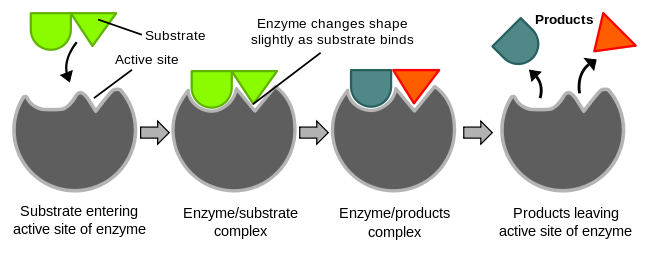
- Enzyme and substrate are complements of each other in terms of shape and chemical properties
- Binding to active site brings the substrate into close physical proximity, creating an enzyme-substrate complex
- The enzyme catalyst the conversion of the substrate into a product, thus changing into an enzyme-product complex
- As the enzyme is not consumed during the reaction, it can continue with another substrate.
- Note: Reaction can go both ways.
Lock & Key hypothesis states that one key to one lock. Thus one enzyme to one particular substrate. The enzymes specificity is due to the complementary shape of the active site and the substrate.
3.6.3 Explain the effects of temperature, pH and substrate concentration on enzyme activity.
Temperature
- Low energy results in insufficient energy for the reaction to take place
- Increasing the temperature will increase the kinetic energy of the substrate and enzyme, thus increasing the chances of collision.
- There is an optimal temperature at which the enzyme could work
- When the temperature is too high, the hydrogen bonds in the enzyme breaks and the enzyme loses its shape thus changing the active site.
pH
- Changing the pH could alter the charge of the enzyme.
- Thus causing a change in shape and changing the active site.
- Enzymes have an optimal pH.
Substrate concentration
- Increasing substrate concentration will increase the chances of collision
- After a certain point, the environment will be too saturated with substrate that the enzymes can't react any faster.
3.6.4 Define denaturation
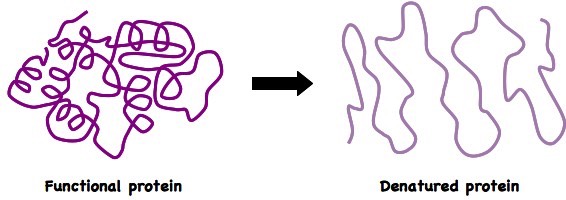
Denaturation is the structural change in the protein that results in the loss of its biological and chemical properties.
3.6.5 Explain the use of lactase in the production of lactose-free milk
Lactose is a disaccharide (Glucose + Ga(lactose)), while lactase is the enzyme that breaks lactose down.
As majority of the human population are somewhat lactose intolerant, the milk industry needs to produce lactose-free milk.
Milk is repeated passed through this process to ensure lactose-free. As enzymes could be easily re-used, this is a cheap and efficient process.
Topic 3.5: Transcription and translation
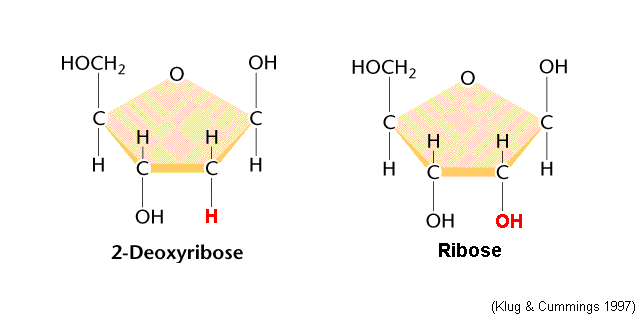
3.5.1 Compare the structure of RNA and DNA
3.5.2 Outline DNA transcription in terms of formation of an RNA strand complementary to the DNA strand by RNA polymerase
The DNA transcription process aims to create mRNA (messenger RNA - carries the codons).
3.5.3 Describe the genetic code in terms of codons composed of triplets of bases.
The genetic code is the set of rules by which information encoded in mRNA sequences is converted into proteins (amino acids sequences) by living cells
3.5.4 Explain the process of translation, leading to polypeptide formation
Translation is the process of protein synthesis in which the genetic information encoded in mRNA is translated into a sequence of amino acids in a polypeptide chain.
3.5.5 Discuss the relationship between one gene and one polypeptide
One gene is transcribed and translated to produce one polypeptide
A gene sequence is converted into a polypeptide sequence via the processes of transcription (making an mRNA transcript) and translation (polypeptide synthesis)
The universality of the genetic code means all organisms show the same relationship between genes and polypeptides (indicating a common ancestry and allowing for transgenic techniques to be employed)
The exceptions to this rules are:
3.5.2 Outline DNA transcription in terms of formation of an RNA strand complementary to the DNA strand by RNA polymerase
The DNA transcription process aims to create mRNA (messenger RNA - carries the codons).
- The DNA helix is unwound using RNA polymerase at the position of the gene
- RNA ribonucleotides triphosphate aligns with their complementary pairs. (Uracil replaces Thymine)
- Once RNA polmerase has full synthesized, the RNA polymerase will detach itself form the DNA molecule and the double helix will reform
- Transcription occurs in the nucleus.
3.5.3 Describe the genetic code in terms of codons composed of triplets of bases.
The genetic code is the set of rules by which information encoded in mRNA sequences is converted into proteins (amino acids sequences) by living cells
- Codons are a triplet of bases which encodes a particular amino acid
- As there are four bases, there are 64 different codon combinations
- The order of the codon determines the amino acid sequence for the protein
- The coding region always starts with the codon (AUG) and end with a stop codon.
The genetic code is universal and degenerate. Every living animal and plants (except a few) uses the exact same coding system. This pronounces the genetic code as universal. It is degenerate because there are a lot of codons which map to the same amino acid. This has no effect seen whatsoever.
3.5.4 Explain the process of translation, leading to polypeptide formation
Translation is the process of protein synthesis in which the genetic information encoded in mRNA is translated into a sequence of amino acids in a polypeptide chain.
- Ribosomes bind to mRNA in the cell's cytoplasm and move along the mRNA molecule in a 5' - 3' direction until it reaches a start codon (AUG)
- Anti-codons on tRNA molecules align opposite appropriate codons according to complementary base pairing
- Each tRNA carries a specific amino acid
- Ribosome catalyse the formation of peptide bonds between adjacent amino acids (via a condensation reaction)
- The ribosome moves along the mRNA molecule synthesizing a polypeptide chain until it reaches a stop codon, at this point translation stops and the polypeptide chain is relesed
3.5.5 Discuss the relationship between one gene and one polypeptide
One gene is transcribed and translated to produce one polypeptide
A gene sequence is converted into a polypeptide sequence via the processes of transcription (making an mRNA transcript) and translation (polypeptide synthesis)
The universality of the genetic code means all organisms show the same relationship between genes and polypeptides (indicating a common ancestry and allowing for transgenic techniques to be employed)
The exceptions to this rules are:
- Genes that are encoding for tRNA and rRNA, aren't creating polypeptides.
- A single gene may code for multiple polypeptides if alternative splicing occurs.
Topic 3.4: DNA replication
3.4.1 Explain DNA replication in terms of unwinding the double helix and separation of the strands by helicase, followed by formation of new complementary strands by DNA polymerase.
Helicase
DNA polymerase
3.4.2 Explain the significance of complementary base pairing in the conservation of the base sequences of DNA
Each of the nitrogenous bases can only pair with its complementary pair.
3.4.3 State that DNA replication is semi-conservative
DNA replication is a semi-conservative process because when a new strand of DNA is formed, one strand will be from the original DNA and one strand will be newly synthesized.
Helicase
- Unwinds the DNA and separates the two polynucleotides strands by breaking the hydrogen bonds between complementary base pairs.
- The two separated polynucleotide strands act as templates for the synthesis of new polynucleotide strands
DNA polymerase
- Synthesis the new strands from the two parental template strands
- Free deoxynucleoside triphosphate are aligned opposite their complementary base partner and are covalently bonded together by DNA polymerase to form a complementary nucleotide chain.
- The energy for this reaction comes from the cleavage of the two extra phosphate groups
3.4.2 Explain the significance of complementary base pairing in the conservation of the base sequences of DNA
Each of the nitrogenous bases can only pair with its complementary pair.
- The significance of the mechanism outlined above is that the DNA molecule is copied precisely from one cell generation to the next
- The new strands formed will be identical to the original strands separated from the template
- The two DNA molecule formed will be identical to the original molecule
3.4.3 State that DNA replication is semi-conservative
DNA replication is a semi-conservative process because when a new strand of DNA is formed, one strand will be from the original DNA and one strand will be newly synthesized.
Topic 3.3: DNA structure
3.3.1 Outline DNA nucleotide structure in terms of sugar (deoxyribose), base and phosphate.
DNA Nucleotide
Deoxyribose is linked to the phosphate group with the 5th carbon and the 3rd carbon
Phosphate group is a phosphate with a negative charge
Nitrogenous Base could include (Adenine, Thymine, Cytosine and Guanine)
3.3.2 State the names of the four bases in DNA
In order with respect to the photo:
Adenine, Guanine, Thymine and Cytosine
Adenine and Guanine are both double ring nitrogenous bases (Purines)
Cytosine and Thymine are both single ring nitrogenous bases (Pyrimidines)
3.3.3 Outline how DNA nucleotides are linked together by covalent bonds into a single strand.
Nucleotides are covalently bonded between the phosphate of one nucleotide to the C3 of the second nucleotide. The phosphate group creates a bridge connecting the C5 on one pentose and the C3 on the other. The bond is called the phosphodiester bond because it involves the phosphate group.
3.3.4 Explain how a DNA double helix is formed using complementary base pairing and hydrogen bonds.
Two polynucleotides of DNA are held together by hydrogen bonds between complementary bases.
Guanine and Cytocine bonds together with a triple hydrogen bond (C=3)
Adenine and Thymine bonds together with a double hydrogen bond.
In order for the nucleotides to face each other, one strand is reversed to the other.
3.3.5 Draw and label a simple diagram of molecular structure of DNA
DNA Nucleotide
Deoxyribose is linked to the phosphate group with the 5th carbon and the 3rd carbon
Phosphate group is a phosphate with a negative charge
Nitrogenous Base could include (Adenine, Thymine, Cytosine and Guanine)
3.3.2 State the names of the four bases in DNA
In order with respect to the photo:
Adenine, Guanine, Thymine and Cytosine
Adenine and Guanine are both double ring nitrogenous bases (Purines)
Cytosine and Thymine are both single ring nitrogenous bases (Pyrimidines)
3.3.3 Outline how DNA nucleotides are linked together by covalent bonds into a single strand.
Nucleotides are covalently bonded between the phosphate of one nucleotide to the C3 of the second nucleotide. The phosphate group creates a bridge connecting the C5 on one pentose and the C3 on the other. The bond is called the phosphodiester bond because it involves the phosphate group.
3.3.4 Explain how a DNA double helix is formed using complementary base pairing and hydrogen bonds.
Two polynucleotides of DNA are held together by hydrogen bonds between complementary bases.
Guanine and Cytocine bonds together with a triple hydrogen bond (C=3)
Adenine and Thymine bonds together with a double hydrogen bond.
In order for the nucleotides to face each other, one strand is reversed to the other.
3.3.5 Draw and label a simple diagram of molecular structure of DNA
Topic 3.2: Carbohydrates, lipids and proteins
3.2.1 Distinguish between organic and inorganic compounds
Compounds containing carbon that are found in living organisms are called organic compounds.
The exceptions are the gas carbon dioxide, hydrogen carbonates and mineral calcium carbonate.
3.2.2 Identify amino acids, glucose, ribose and fatty acids from diagrams showing their structure.
3.2.3 List three examples each of monosaccharides, disaccharides and polysaccharides.
3.2.4 State one function of glucose, lactose and glycogen in animals, and of fructose, sucrose and cellulose in plants.
Monosaccharides-
Glucose - (Animals and Plants) used for cellular respiration
Galactose - (Animals) Used for production of milk
Fructose - (Plants) Used in the production of sucrose
Disaccharides-
Lactose - (Animals) (Glucose + Galactose) Produced in mammary glands
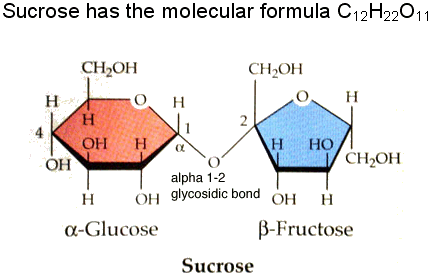
Sucrose - (Plants) (Glucose + Fructose) Produced in green leaves
Maltose - (Plants) (Glucose + Glucose) Breakdown product in the hydrolysis of starch
Polysaccharides-
Glycogen - (Animals) Storage carbohydrates, stored in the liver and other cells
Starch - (Plants) Storage for carbohydrates
Cellulose - (Plants) Bundle of fibres as the main component of the cell walls.
3.2.5 Outline the role of condensation and hydrolysis in the relationships between monosaccharides, disaccharides and polysaccharides; between fatty acids, glycerol and triglycerides; and between amino acids and polypeptides.
Condensation Reaction: (Water is formed; similar to "condensation")
Hydrolysis Reaction: (Water is broken down; "lysis" refers to breaking down)
Monosaccharides forming a disaccharide: (Glycosidic Bond)
Fatty acids and Glycerol forming triglycerides: (Ester Bond)
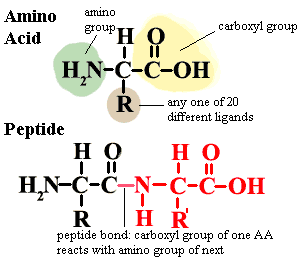
Amino acids forming a polypeptide: (Peptide Bond)
3.2.6 State three functions of lipids
Structure: Phospholipids in the cell membrane allows for the cell to maintain its shape
Heat Insulation: A layer of fat under the skin to reduce heat loss
Buoyancy: Lipids are less dense than water, this allows animals to float
Energy Storage: Stores energy in the form of fat.
3.2.7 Compare the use of carbohydrates and lipids in energy storage.
Similarities:
Compounds containing carbon that are found in living organisms are called organic compounds.
The exceptions are the gas carbon dioxide, hydrogen carbonates and mineral calcium carbonate.
3.2.2 Identify amino acids, glucose, ribose and fatty acids from diagrams showing their structure.
3.2.3 List three examples each of monosaccharides, disaccharides and polysaccharides.
Monosaccharides
Glucose
Galactose
Fructose
Disaccharides
Lactose
Sucrose
Maltose
Polysaccharides
Glycogen
Starch
Cellulose
3.2.4 State one function of glucose, lactose and glycogen in animals, and of fructose, sucrose and cellulose in plants.
Monosaccharides-
Glucose - (Animals and Plants) used for cellular respiration
Galactose - (Animals) Used for production of milk
Fructose - (Plants) Used in the production of sucrose
Disaccharides-
Lactose - (Animals) (Glucose + Galactose) Produced in mammary glands
Sucrose - (Plants) (Glucose + Fructose) Produced in green leaves
Maltose - (Plants) (Glucose + Glucose) Breakdown product in the hydrolysis of starch
Polysaccharides-
Glycogen - (Animals) Storage carbohydrates, stored in the liver and other cells
Starch - (Plants) Storage for carbohydrates
Cellulose - (Plants) Bundle of fibres as the main component of the cell walls.
3.2.5 Outline the role of condensation and hydrolysis in the relationships between monosaccharides, disaccharides and polysaccharides; between fatty acids, glycerol and triglycerides; and between amino acids and polypeptides.
Condensation Reaction: (Water is formed; similar to "condensation")
Hydrolysis Reaction: (Water is broken down; "lysis" refers to breaking down)
Monosaccharides forming a disaccharide: (Glycosidic Bond)
Fatty acids and Glycerol forming triglycerides: (Ester Bond)
Amino acids forming a polypeptide: (Peptide Bond)
3.2.6 State three functions of lipids
Structure: Phospholipids in the cell membrane allows for the cell to maintain its shape
Heat Insulation: A layer of fat under the skin to reduce heat loss
Buoyancy: Lipids are less dense than water, this allows animals to float
Energy Storage: Stores energy in the form of fat.
3.2.7 Compare the use of carbohydrates and lipids in energy storage.
Similarities:
- Complex carbohydrates (polysaccharides) and lipids both contain a lot of chemical energy and be used for energy storage
- Complex carbohydrates and lipids are both insoluble in water
- Carbohydrates and lipids both burn cleaner than proteins (They do not yield nitrogenous gas)
Differences:
- Lipids molecules contain more energy per gram than carbohydrates (2x)
- Carbohydrates are more readily digested than lipids and release their energy more rapidly
- Monosaccharides and disaccharides are water-soluble and easier to transport
- Animals tend to use carbohydrates primarily for short-term storage, while lipids are used more for long-term energy storage
- Carbohydrates are stored as glycogen in animals while lipids is stored in fat.
Topic 3.1: Chemical elements and water
3.1.1 State that the most frequently occurring chemical elements in living things are carbon, hydrogen, oxygen and nitrogen.
99% of living matter consists of just four elements: carbon, hydrogen, oxygen and nitrogen because living things contain large quantities of water. Carbon combined with hydrogen and oxygen forms carbohydrates and lipids. The element nitrogen is combined with carbon, hydrogen and oxygen in compounds called amino acids from which proteins are constructed.
3.1.2 State that a variety of other elements are needed by living organisms, including sulfur, calcium, phosphorus, iron and sodium.
Sulfur
Calcium
Phosphorus
Iron
Sodium
3.1.3 State one role for each of the elements mentioned in 3.1.2
Sulphur
In plants, animals and prokaryotes
Calcium
In plants
3.1.4 Draw and label a diagram showing the structure of water molecules to show their polarity and hydrogen bond formation.
The hydrogen ions atom has a strong positive charge to other electron lone pairs. It creates a hydrogen bond which is an electrostatic attraction between the positively charged region of one water molecule and the negatively charged region of a neighbouring one.
3.1.5 Outline the thermal, cohesive and solvent properties of water.
Thermal properties of water
Heat energy and temperature of water requires a lot of energy to raise the temperature of water. This is because much energy is needed to break the hydrogen bonds that restrict the movements of water molecules. The specific heat capacity is high
Evaporation and heat loss and the amount of energy is the high latent heat of vaporisation. The evaporation of water in sweat on the skin, or in transpiration from green leaves. This leaves the surface very cool.
Heat energy and freezing requires a high amount of energy which is the latent heat of fusion. As a result, both the content of cells and the water in the environment are always slow to freeze in extreme cold.
The density of ice is lower than water hence ice floats. This allows aquatic life to survive below the ice.
Cohesive properties of water
Cohesion is the force by which individual molecules stick together. Water molecules tick together as a result of hydrogen bonding. Adhesion is the force by which individual molecules cling to surrounding materials and surface. Materials with an affinity for water are describe as hydrophilic. The outermost molecules of water form hydrogen bonds with the water molecules below them which creates the property of surface tension.
Below the surface, water molecules slide past each other very easily. This property is described as low viscoity.
Solvent properties of water
Water is a powerful solvent for polar substances. Ionic substance, cations and anions become surrounded by a shell of oriented water molecules. Carbon-containing (organic) molecules with ionised groups (such as the carboxyl group -COO- and the amino group -NH3+). Soluble organic molecules like sugar dissolve in water due to the formation of hydrogen bonds with their slightly charged hydroxyl groups (-OH).
3.1.6 Explain the relationship between the properties of water and its uses in living organisms as a coolant, medium for metabolic reactions and transport medium.
A liquid at room temperature, water dissolves more substances than any other common liquid
99% of living matter consists of just four elements: carbon, hydrogen, oxygen and nitrogen because living things contain large quantities of water. Carbon combined with hydrogen and oxygen forms carbohydrates and lipids. The element nitrogen is combined with carbon, hydrogen and oxygen in compounds called amino acids from which proteins are constructed.
3.1.2 State that a variety of other elements are needed by living organisms, including sulfur, calcium, phosphorus, iron and sodium.
Sulfur
Calcium
Phosphorus
Sodium
3.1.3 State one role for each of the elements mentioned in 3.1.2
Sulphur
In plants, animals and prokaryotes
- In some amino acids and proteins
- In some vitamins
Calcium
In plants
- Cell wall formation between dividing plant cells
- co-factor for certain enzymes
- Constituent of bones
- reacts in muscle fibre contraction, blood clotting and synapse
- co-factor for certain enzymes
In prokaryotes
- Co-factor for certain enzymes
- contributes to heat resistance of bacterial endospores
Phosphorus
In plants, animals or prokaryotes
- Synthesis of nucleotides
- ATP
- Constituent of bones (animals only)
Iron
In plants, animals or prokaryotes
- Constituent of electron transport molecules
- Chlorophyll synthesis (In plants and prokaryotes only)
Sodium
In plants, animals or prokaryotes
- Involved with potassium in membrane function
- Nerve impulse transport (animals only)
3.1.4 Draw and label a diagram showing the structure of water molecules to show their polarity and hydrogen bond formation.
The hydrogen ions atom has a strong positive charge to other electron lone pairs. It creates a hydrogen bond which is an electrostatic attraction between the positively charged region of one water molecule and the negatively charged region of a neighbouring one.
3.1.5 Outline the thermal, cohesive and solvent properties of water.
Thermal properties of water
Heat energy and temperature of water requires a lot of energy to raise the temperature of water. This is because much energy is needed to break the hydrogen bonds that restrict the movements of water molecules. The specific heat capacity is high
Evaporation and heat loss and the amount of energy is the high latent heat of vaporisation. The evaporation of water in sweat on the skin, or in transpiration from green leaves. This leaves the surface very cool.
Heat energy and freezing requires a high amount of energy which is the latent heat of fusion. As a result, both the content of cells and the water in the environment are always slow to freeze in extreme cold.
The density of ice is lower than water hence ice floats. This allows aquatic life to survive below the ice.
Cohesive properties of water
Cohesion is the force by which individual molecules stick together. Water molecules tick together as a result of hydrogen bonding. Adhesion is the force by which individual molecules cling to surrounding materials and surface. Materials with an affinity for water are describe as hydrophilic. The outermost molecules of water form hydrogen bonds with the water molecules below them which creates the property of surface tension.
Below the surface, water molecules slide past each other very easily. This property is described as low viscoity.
Solvent properties of water
Water is a powerful solvent for polar substances. Ionic substance, cations and anions become surrounded by a shell of oriented water molecules. Carbon-containing (organic) molecules with ionised groups (such as the carboxyl group -COO- and the amino group -NH3+). Soluble organic molecules like sugar dissolve in water due to the formation of hydrogen bonds with their slightly charged hydroxyl groups (-OH).
3.1.6 Explain the relationship between the properties of water and its uses in living organisms as a coolant, medium for metabolic reactions and transport medium.
A liquid at room temperature, water dissolves more substances than any other common liquid
- Liquid medium for living things and for the chemistry of life
Much heat energy needed to raise the temperature of water
- Aquatic environment slow to change temperature
- Bulky organisms have stable temperatures
Evaporation requires a great deal of heat
- Evaporation causes marked colling (much heat is lost by evaporation of a small quantity of water)
Much heat has to be removed before freezing occurs
- Cell contents and water in aquatic environments are slow to freeze in cold weather
Ice is at maximum density at 4°C
- Ice forms on the surface of water, insulating the water below and allowing much aquatic life to survive freezing
Surface water molecules orientate with hydrogen bonds formed inwards
- Water forms droplets and rolls off surface
- Certain animals exploit surface tension to move over water surface
Water molecules slide past each other easily (low viscosity)
- Water flows easily through narrow capillaries, and through tiny spaces (e.g. in soils, spaces in cell walls)
Water molecules adhere to surfaces
- Water adheres to walls of xylem vessels as it is drawn up the stem to the leaves, from the roots
Water column does not break or pull apart under tension
- Water can be lifted by forces applied at the top, and so can be drawn up xylem vessels of tree trunks by forces generated in the leaves
Water is transparent
- Aquatic plants can photosynthesis at some depth in water
訂閱:
文章 (Atom)